













Robot Madness: Will Cyborgs Compromise Privacy?

In Robot Madness, LiveScience examines humanoid robots and cybernetic enhancement of humans, as well as the exciting and sometimes frightening convergence of it all. Return for a new episode each Monday, Wednesday and Friday through April 6.
People who talk with one-eyed filmmaker Robert Spence may find it creepy to realize they're staring into a bionic eye camera – and that's the entire point of the "EyeBorg" project.
Spence wants to raise awareness of concerns in an increasingly networked society, by using a wireless video camera disguised as a natural eye to create a documentary. The purpose, he says, is to highlight privacy issues raised by technologies which have become hidden in modern life.
This goes beyond Google Maps catching embarrassing images of sunbathers, or surveillance cameras recording pedestrians 24/7 in cities such as New York and London. It's about "smart" or "ambient intelligence" systems embedded in everything from store goods to human bodies, and often hidden from obvious view.
Such systems provide a smorgasbord of information that can help stores move goods more efficiently or doctors better treat their patients, but also challenge traditional ideas of privacy. For instance, Wal-Mart and other major retailers have already tested how to track consumer habits with radio frequency identification (RFID), by embedding RFID tags in the products such as lipstick.
Still, many consumers already tote around iPhones and other gadgets that allow them to stay connected almost constantly with a vast network of information about people and places. And more daring individuals have even become "lifecasters" by streaming constant video from their life onto Web sites such as Justin.tv.
{{ video="LS_090309_06_ImEnIn" title="Implanted. Enhanced. Invaded?: Human-Robot Mergers" caption="The coming convergence of human and machine comes up from the bottom (with micro-bots and nano-cytes) and down from the top (with mecha). Credit: Thomas Lucas, Producer / Rob Goldberg, Writer" }}
Get the world’s most fascinating discoveries delivered straight to your inbox.
"I don't really want to be a lifecaster," Spence told LiveScience, although lifecasting pioneer Steve Mann at the University of Toronto is helping figure out some real-time streaming capabilities for the bionic eye. Instead, Spence wants to focus attention on how people's desire for information through technology can compromise their individual privacy.
Experts have pointed out that people who wear eyeglasses, contacts and hearing aids have already become cyborgs, in a sense. So it's not a huge leap to imagine people wanting upgraded versions of such items that allow them to check the weather, or see the status of friends while on the go — although friends and strangers could also check on them.
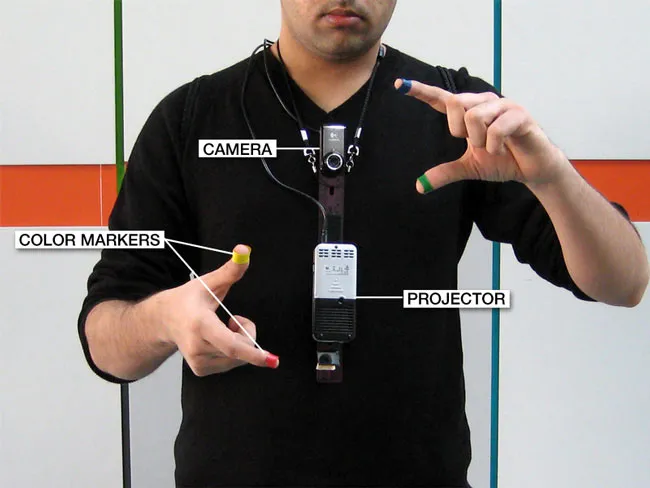
MIT's Media Lab unveiled a futuristic prototype along those lines early this year, called "Sixth Sense," which combined a webcam and small projector with a wirelessly connected mobile phone.
A Sixth Sense demonstration video at the TED Conference in California this winter showed MIT student Pranav Mistry flipping through a book, and then having Sixth Sense automatically search online and project book information onto the cover. Another demo example showed Sixth Sense detecting and then projecting personal information about a student who was engaged in conversation with Mistry.
Big picture issues aside, Spence first wants to get his bionic eye cam up and running. But he's not too worried about having his documentary spoiled by advance publicity.
"Even though I've had so much press, most people wouldn't recognize me," Spence said. He's lucky that no one has a Sixth Sense just yet.
Robot Madness Episode 7: Sex with Robots
- Video - Implanted. Enhanced. Invaded? Human-Robot Mergers
- Robot Madness Episode 5: Walk Like Humans Do
- More Robot News and Information
