Mantis at the Movies: Tiny Specs Reveal Bugs' 3D Vision

Get the world’s most fascinating discoveries delivered straight to your inbox.
You are now subscribed
Your newsletter sign-up was successful
Want to add more newsletters?
Delivered Daily
Daily Newsletter
Sign up for the latest discoveries, groundbreaking research and fascinating breakthroughs that impact you and the wider world direct to your inbox.
Once a week
Life's Little Mysteries
Feed your curiosity with an exclusive mystery every week, solved with science and delivered direct to your inbox before it's seen anywhere else.
Once a week
How It Works
Sign up to our free science & technology newsletter for your weekly fix of fascinating articles, quick quizzes, amazing images, and more
Delivered daily
Space.com Newsletter
Breaking space news, the latest updates on rocket launches, skywatching events and more!
Once a month
Watch This Space
Sign up to our monthly entertainment newsletter to keep up with all our coverage of the latest sci-fi and space movies, tv shows, games and books.
Once a week
Night Sky This Week
Discover this week's must-see night sky events, moon phases, and stunning astrophotos. Sign up for our skywatching newsletter and explore the universe with us!
Join the club
Get full access to premium articles, exclusive features and a growing list of member rewards.
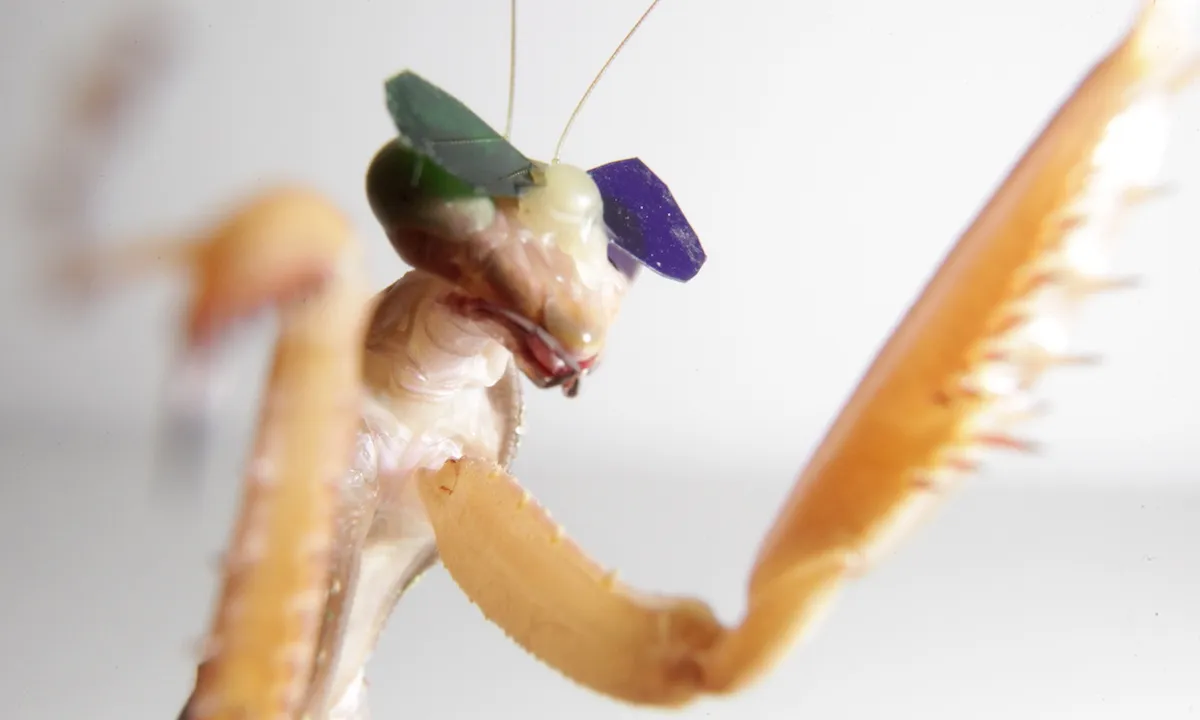
By fitting praying mantises with teeny, tiny glasses, scientists have proved that these insects have 3D vision.
"Despite their minute brains, mantises are sophisticated visual hunters which can capture prey with terrifying efficiency. We can learn a lot by studying how they perceive the world," study researcher Jenny Read, a professor of vision science at Newcastle University in the United Kingdom, said in a statement.
To determine whether insects use 3D vision to hunt, Read and her colleagues had to come up with a way to show mantises both two- and three-dimensional images. So the researchers invented mantis 3D movies.
It was a trial-and-error process. Modern 3D glasses, like the ones people might wear to go see "The Force Awakens" in 3D IMAX, didn't work, because the mantises were too close to the screen. Old-school red-and-blue lenses wouldn't work either, because mantises don't see red light well, the researchers wrote Jan. 7 in the journal Scientific Reports.
So the researchers created custom glasses with blue-and-green lenses and attached them to the mantises' bulging eyes with beeswax. The scientists then showed the insects videos of spiraling disks in either 2D or 3D, which looked to the mantises like insect prey. [Gallery: Out-of-This-World Images of Insects]
The mantises struck at 3D "insects" much more than they did 2D "insects," the researchers found. This shows that mantises use stereopsis, or the slight difference in images from each eye, to see in 3D.
Prior to this study, no one had been able to study stereopsis in insects, the researchers wrote, because there was no way to show the little creepy crawlies stimuli in two or three dimensions interchangeably.
Get the world’s most fascinating discoveries delivered straight to your inbox.
"This technique opens up broad new avenues of research," the investigators wrote. In other words, expect to see spectacles on more bugs in the future.
Follow Stephanie Pappas on Twitterand Google+. Follow us @livescience, Facebook& Google+. Original article on Live Science.

Stephanie Pappas is a contributing writer for Live Science, covering topics ranging from geoscience to archaeology to the human brain and behavior. She was previously a senior writer for Live Science but is now a freelancer based in Denver, Colorado, and regularly contributes to Scientific American and The Monitor, the monthly magazine of the American Psychological Association. Stephanie received a bachelor's degree in psychology from the University of South Carolina and a graduate certificate in science communication from the University of California, Santa Cruz.