How Robots Are Made To Move Like Animals (Infographic)
Get the world’s most fascinating discoveries delivered straight to your inbox.
You are now subscribed
Your newsletter sign-up was successful
Want to add more newsletters?
Delivered Daily
Daily Newsletter
Sign up for the latest discoveries, groundbreaking research and fascinating breakthroughs that impact you and the wider world direct to your inbox.
Once a week
Life's Little Mysteries
Feed your curiosity with an exclusive mystery every week, solved with science and delivered direct to your inbox before it's seen anywhere else.
Once a week
How It Works
Sign up to our free science & technology newsletter for your weekly fix of fascinating articles, quick quizzes, amazing images, and more
Delivered daily
Space.com Newsletter
Breaking space news, the latest updates on rocket launches, skywatching events and more!
Once a month
Watch This Space
Sign up to our monthly entertainment newsletter to keep up with all our coverage of the latest sci-fi and space movies, tv shows, games and books.
Once a week
Night Sky This Week
Discover this week's must-see night sky events, moon phases, and stunning astrophotos. Sign up for our skywatching newsletter and explore the universe with us!
Join the club
Get full access to premium articles, exclusive features and a growing list of member rewards.
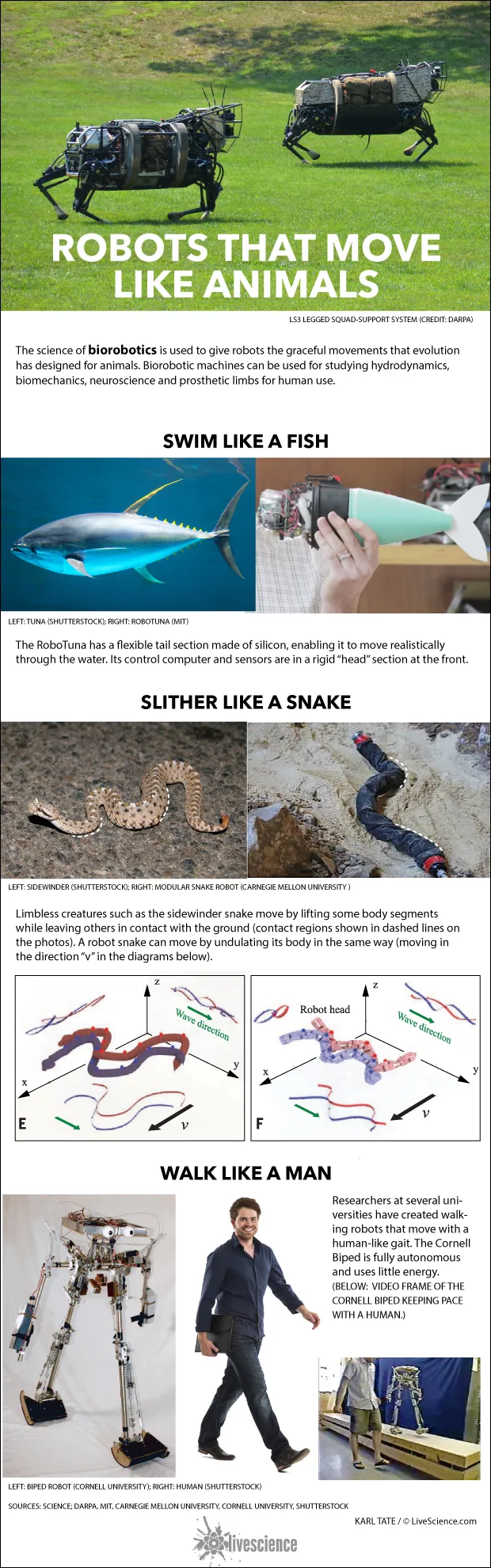
The science of biorobotics is used to give robots the graceful movements that evolution has designed for animals. Biorobotic machines can be used for studying hydrodynamics, biomechanics, neuroscience and prosthetic limbs for human use.
The RoboTuna has a flexible tail section made of silicon, enabling it to move realistically through the water. Its control computer and sensors are in a rigid “head” section at the front.
Limbless creatures such as the sidewinder snake move by lifting some body segments while leaving others in contact with the ground. A robot snake can move by undulating its body in the same way.
Researchers at several universities have created walking robots that move with a human-like gait. The Cornell Biped is fully autonomous and uses little energy.
Get the world’s most fascinating discoveries delivered straight to your inbox.