













Painkiller Prescribing Rates Vary Widely by State, CDC Says

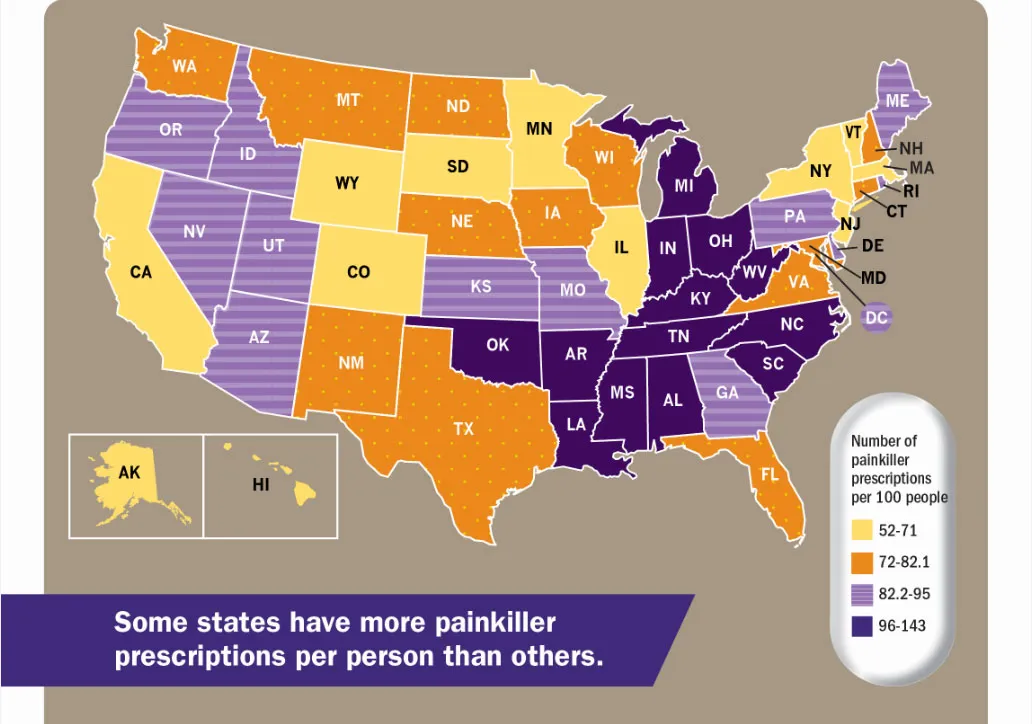
The rate of prescriptions that doctors write for painkillers varies widely by state, with states in the South having some of the highest rates, according to a new report from the Centers for Disease Control and Prevention.
The report highlights the urgent need to change prescribing practices in states with particularly high rates of painkiller prescriptions, because the overprescribing of these drugs can result in fatal overdoses, the CDC said.
In 2012, there were 259 million prescriptions written for opioid painkillers in the United States, which is enough for every adult in the country to have a bottle of pills, the report said. [How 8 Common Medications Interact with Alcohol]
Southern states — particularly Alabama, Tennessee and West Virginia — had the most painkiller prescriptions per person, the report said. For example, in Alabama, there were 143 prescriptions for opioid prescriptions written for every 100 people. That's about three times the rate seen in Hawaii, which had the lowest rate among U.S. states, with 52 prescriptions per 100 people.
The rate of prescriptions for oxymorphone, one type of opioid painkiller, was about 22 times higher in Tennessee than in Minnesota, which had the lowest rate of prescriptions for that drug, the report said.
Prescription rates for long-acting/extended-release painkillers, and for high-dose painkillers, were the highest in the Northeast, particularly in Maine and New Hampshire, the report said.
Such wide variations in prescriptions for painkillers cannot be explained by differences in the health of people in different states — that is, pain-related health issues don't vary much by region, the CDC said.
Get the world’s most fascinating discoveries delivered straight to your inbox.
Rather, the differences may indicate a lack of consensus about when it is appropriate to prescribe painkillers, the report said.
"We're not seeing consistent, effective, appropriate prescribing of painkillers across the nation, and this is a problem because of the deaths that result," Dr. Tom Frieden, director of the CDC, said at a news conference today (July 1). "All states, but especially those whose prescribing rates are highest, need to examine whether the drugs are being used appropriately."
Opioid medications can be dangerous because they are very addictive, and can suppress breathing and result in death, Frieden said. In 2011, nearly 17,000 deaths involved overdoses of opioid painkillers, the CDC said.
One way in which states can address the overprescribing of painkillers is to increase their use of databases known as prescription-drug monitoring programs, which track patients' painkiller prescriptions, the CDC said. These databases can help identify prescribing problems, such as when multiple doctors are prescribing painkillers to the same patient.
Since 2012, when New York State started requiring that doctors check the state's prescription-drug monitoring program before prescribing painkillers, the state saw a 75 percent drop in patients who were seeing multiple doctors to obtain the same painkillers, the CDC said. And since 2010 when Florida started to regulate pain clinics, to stop doctors from dispensing prescription painkillers from their offices, the state saw a more than 50 percent decrease in overdose deaths from the opioid oxycodone.
States can also find ways to increase access to substance-abuse treatment for people addicted to painkillers, Frieden said.
Moreover, doctors can discuss the risks and benefits of pain treatments with patients, including treatments that do not involve prescription painkillers, Frieden said.
"Some conditions are best treated with opioid, but they are not the answer to every time someone has pain," Frieden said.
Follow Rachael Rettner @RachaelRettner. Follow Live Science @livescience, Facebook & Google+. Original article on Live Science.

Rachael is a Live Science contributor, and was a former channel editor and senior writer for Live Science between 2010 and 2022. She has a master's degree in journalism from New York University's Science, Health and Environmental Reporting Program. She also holds a B.S. in molecular biology and an M.S. in biology from the University of California, San Diego. Her work has appeared in Scienceline, The Washington Post and Scientific American.