













Flight of Fancy: Piloting Planes with Mind Control

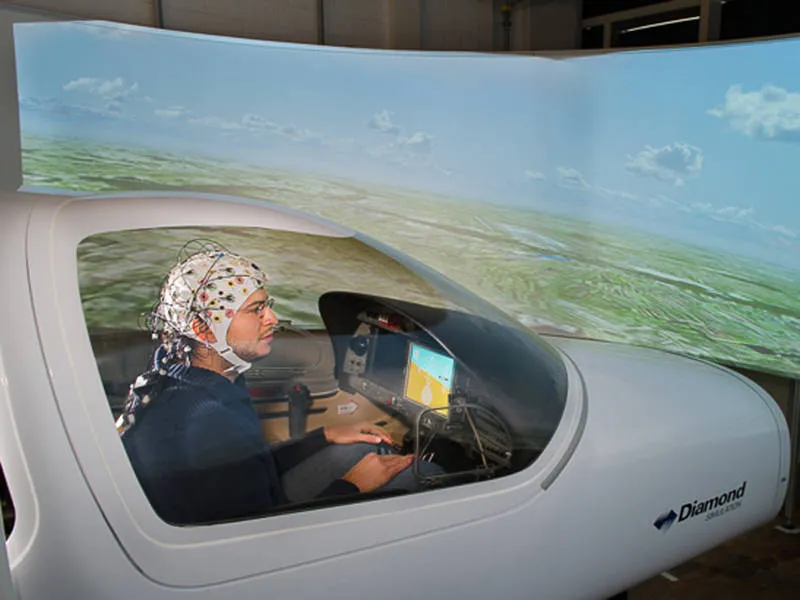
Self-driving cars have already arrived, at least in the testing stage, and now mind-controlled flight could be on the horizon, researchers say.
A team of engineers developed an algorithm that can convert brain waves into flight commands. The researchers hope the mind-controlled system paired with specialized airplane controls will make flying easier and safer in the future.
"If flying is more intuitive, it is also easier and thus safer," Tim Fricke, an aerospace engineer at Technische Universität München in Germany, who helped develop the system, told Live Science. "Moderately trained general aviation pilots with [little] flying experience would probably benefit the most from this new approach." [Supersonic! The 10 Fastest Military Airplanes]
During the virtual flying simulations, researchers fitted seven pilots with a white cap covered with dozens of electroencephalography (EEG) cables to record the subjects' brain waves. Each pilot had varying degrees of experience, including one who had never been in an airplane cockpit. The EEG cables sent electrical signals to a computer, which was running the mind-control algorithm; the computer then converted the electric signals into an action that was carried out wirelessly.
Brain waves have distinct patterns, so the algorithm can specifically target the pilots' plane-control thoughts.
Just by thinking commands, the pilots who participated in the experiment were able to complete maneuvers such as takeoffs and landings, and they were able to keep the plane within a few degrees of a given compass direction, the researchers said. The pilots' accuracy surprised the team; if the simulations had been real flights, each of the participants would have passed all the requirements in a pilot license test. Some pilots even landed the plane on the runway in stormy conditions with poor visibility, the researchers said.
However, the mind-control technique has limitations. During flight, pilots rely on the resistance they feel from the physical controls in order to keep the plane on track through clouds and high winds, the researchers said. In mind-controlled flight, the pilots lack this feedback. Researchers need to design a way to signal to the pilots when they are overcorrecting, Fricke said, adding that this could be accomplished by giving the pilots a visual or auditory signal.
Get the world’s most fascinating discoveries delivered straight to your inbox.
The successful simulations do not mean all pilots will suddenly start trading in their captain's hats for EEG caps, the researchers said.
"Brain-computer interface technology is still quite young, and although we might see some amazing developments in the next years, wide application is still decades away, especially when we talk about controlling aircraft, where [the] highest safety standards have to be respected," Fricke said.
Next, the researchers will work on getting the algorithm ready for an unmanned demonstration flight.
The team will present their results, which have not yet been published in a peer-reviewed scientific journal, in September at the German Aerospace Congress (DLRK) in Augsburg, Germany.
Follow Kelly Dickerson on Twitter. Follow us @livescience, Facebook & Google+. Original article on Live Science.
