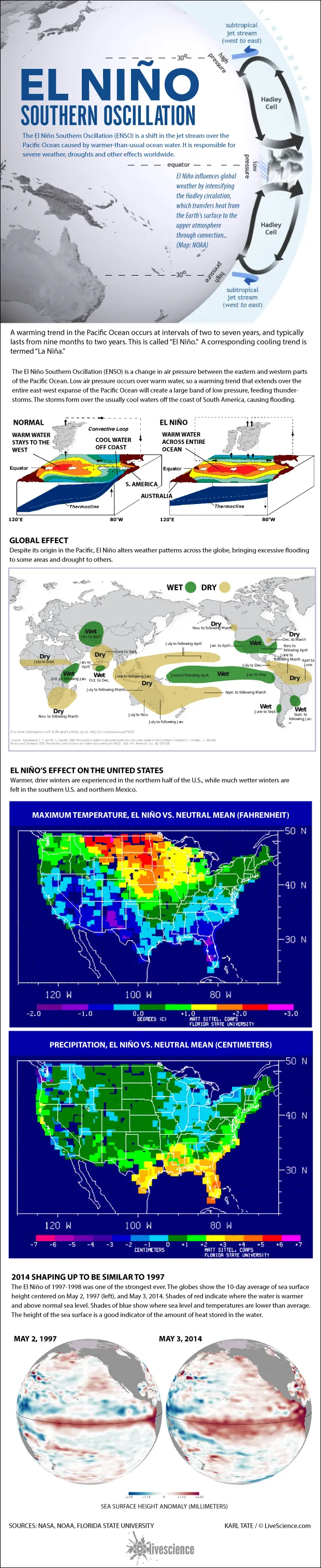
How El Niño Causes Wild Weather All Over the Globe (Infographic)
Get the world’s most fascinating discoveries delivered straight to your inbox.
You are now subscribed
Your newsletter sign-up was successful
Want to add more newsletters?
Delivered Daily
Daily Newsletter
Sign up for the latest discoveries, groundbreaking research and fascinating breakthroughs that impact you and the wider world direct to your inbox.
Once a week
Life's Little Mysteries
Feed your curiosity with an exclusive mystery every week, solved with science and delivered direct to your inbox before it's seen anywhere else.
Once a week
How It Works
Sign up to our free science & technology newsletter for your weekly fix of fascinating articles, quick quizzes, amazing images, and more
Delivered daily
Space.com Newsletter
Breaking space news, the latest updates on rocket launches, skywatching events and more!
Once a month
Watch This Space
Sign up to our monthly entertainment newsletter to keep up with all our coverage of the latest sci-fi and space movies, tv shows, games and books.
Once a week
Night Sky This Week
Discover this week's must-see night sky events, moon phases, and stunning astrophotos. Sign up for our skywatching newsletter and explore the universe with us!
Join the club
Get full access to premium articles, exclusive features and a growing list of member rewards.
The El Niño Southern Oscillation (ENSO) is a shift in the jet stream over the Pacific Ocean caused by warmer-than-usual ocean water. It is responsible for severe weather, droughts and other effects worldwide.
El Niño influences global weather by intensifying the Hadley circulation, which transfers heat from the Earth's surface to the upper atmosphere through convection.
A warming trend in the Pacific Ocean occurs at intervals of two to seven years, and typically lasts from nine months to two years. This is called “El Niño.” A corresponding cooling trend is termed “La Niña.”
El Niño is a change in air pressure between the eastern and western parts of the Pacific Ocean. Low air pressure occurs over warm water, so a warming trend that extends over the entire east-west expanse of the Pacific Ocean will create a large band of low pressure, feeding thunderstorms. The storms form over the usually cool waters off the coast of South America, causing flooding.
Despite its origin in the Pacific, El Niño alters weather patterns across the globe, bringing excessive flooding to some areas and drought to others. Warmer, drier winters are experienced in the northern half of the U.S., while much wetter winters are felt in the southern U.S. and northern Mexico.
Get the world’s most fascinating discoveries delivered straight to your inbox.