














Strange Rocks Found in Earth's Crustal Graveyard

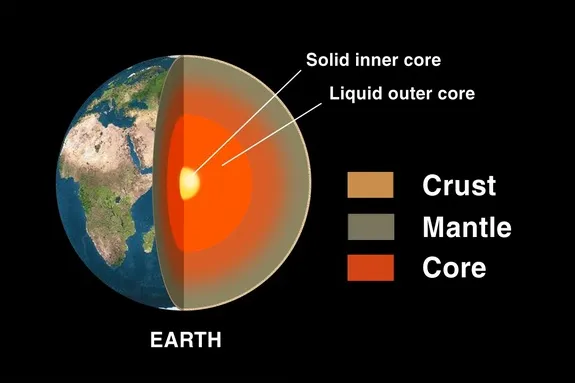
Models of how the Earth's mantle works may need to change, thanks to two new studies that recreate the extreme conditions just above the planet's core.
The deep mantle, a region that lies 416 to 1,800 miles (670 to 2,900 kilometers) below the Earth's surface, is impossible to reach and hard to "see" clearly with seismic signals. The little scientists do know about the mantle comes from earthquake waves, which speed up and slow down as they travel through different rock layers inside the Earth. The deepest part of the mantle has weird blobs and seismic slow zones that have long puzzled scientists. Both new studies offer possible explanations for the strange seismic behavior.
In the studies, researchers mimicked conditions inside the deep mantle with experiments in the laboratory. Teams working independently on different continents shot lasers at tiny specks of rock squeezed between diamond anvils.
One team concluded that scientists had been wrong about the form that a certain rock takes in the deep mantle, which accounts for about half of Earth's volume. The other team found evidence for small amounts of Earth's most common surface rock, basalt, pooling in liquid form at the core-mantle boundary. The findings are published today (May 22) in the journal Science. [Infographic: Tallest Mountain to Deepest Ocean Trench]
"These results are a new step forward in reproducing in the laboratory what is occurring in the very deep mantle," said Denis Andrault, lead author of one of the studies and a scientist at Blaise Pascal University in France.
Mantle mineral mutations
The study examining the form of mantle rocks found that a mineral called perovskite, which makes up about 80 percent of the deep mantle, behaves differently at depths greater than 1,365 miles (2,200 km) than it does above that level.
Get the world’s most fascinating discoveries delivered straight to your inbox.

It turns out that in the lowest part of the mantle, perovskite has two phases — different ways of arranging its atoms. One "H-phase" has iron and a hexagonal structure, while the other phase is iron-free. The H-phase is more stable at the temperatures and pressures found close to the core, and is likely more common than the iron-free form of perovskite, said lead study author Li Zhang, a scientist at the Center for High Pressure Science and Technology Advanced Research in Shanghai.
The findings suggest that the mineral makeup of the bottom half of the lower mantle may be different than that of the top half, Zhang said. "The constitution of the Earth's lower mantle may be significantly different than previously thought," he said.
Geoscientists classify the inner Earth's layers according to the changes in rock type, which are often indicated by sudden changes in earthquake wave speeds. The discovery of the H-phase will spark a search through the deep Earth for places where perovskite changes over to the H-phase, the researchers said. [What is Earth Made Of?]
Discovering the new H-phase also opens up possibilities for improving models of Earth's interior, said Quentin Williams, a professor at the University of California, Santa Cruz, who was not involved in the studies. Researchers can now better explore how the transition from one mineral phase to another influences the planet's tectonic convection cycle, and whether there is a seismic signal of the change.
"The idea that 1,000 km above Earth's core, the material might separate into iron-rich and iron-poor minerals is quite new," Williams said.
Crust at the core
Researchers who model processes inside the Earth will also need to consider the effects of the other diamond-anvil experiment published in Science this week.

The second study, by the team from Blaise Pascal University, indicates that foundered fragments of oceanic crust can melt at the core-mantle boundary. This is not a simple conclusion; basalt may melt easily beneath erupting volcanoes, but deep-mantle rocks behave weirdly because pressures there are a million times greater than at Earth's surface. And temperatures in the deep mantle are scorching: Estimates run from about 2,800 to 6,700 degrees Fahrenheit, or 1,530 to 3,700 degrees Celsius, though no one knows for sure.
The new experiments revealed that oceanic crust (the basalt) melts at a lower temperature than surrounding mantle rocks do in the zone just above the core-mantle boundary, 1,800 miles (2,900 km) deep. The basalt stays molten only when it's contained in the old oceanic crust, the researchers think. As soon as the melt escapes upward into the mantle, the chemical mixing with mantle rocks turns the liquid back into a solid. [50 Amazing Facts About Earth]
The findings will influence the debate over how long molten crust pools near the core, what the source of the liquid is and how the new evidence may influence theories about the mantle plumes that feed hotspots and transfer heat within the Earth.
"I find it exciting that the most common rock type at Earth's surface may be responsible for structure directly above Earth's core," Williams said.
The deep mantle is like Earth's storage closet. Some researchers think the blobs of molten rock above the core could be rock stashed there from when the planet formed 4.5 billion years ago. But other scientists think the convection cycle that drives plate tectonics regularly brings old material up to the surface, making the deep-mantle liquid more like short-term storage ponds than a hoarding spot.
Andrault thinks his new findings point toward the latter mode.
"The Earth remains a very dynamic planet," Andrault said.
Email Becky Oskin or follow her @beckyoskin. Follow us @OAPlanet, Facebook and Google+. Original article at Live Science's Our Amazing Planet.
