














Crushing Rocks Reveals Magma Mantle Mysteries

Crushing lovely green gems at horrendous pressures has helped geologists solve a long-standing mystery about Earth's deep inner layers.
Peridotite, which glows like a green cat's eye, is one of the most common minerals in the mantle, the slushy zone between Earth's stiff crust and dense iron core. Home to a rolling mass of rising and falling material, the slow but constant convection brings materials from deep within the planet to the surface through volcanic hot spots and mid-ocean ridges — openings into the mantle where Earth's tectonic plates spread apart.
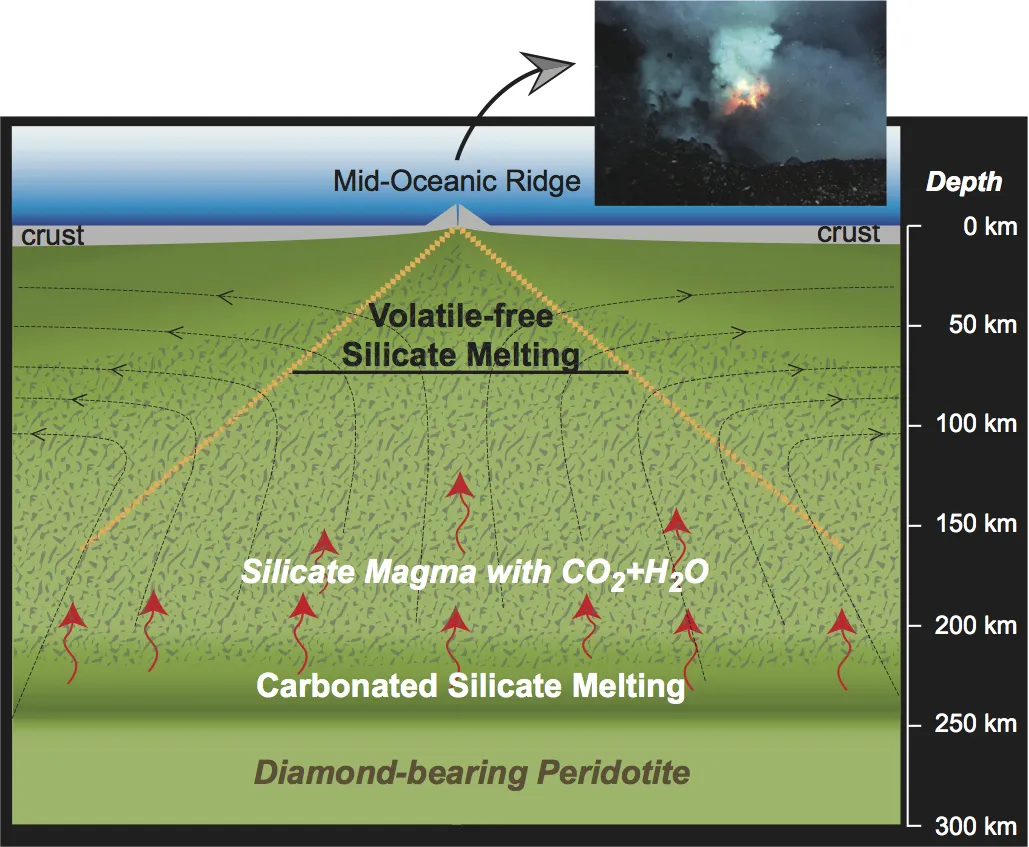
Because of the tremendous pressure in the mantle from overlying rock, geologists believe mantle material wouldn't melt until it rose up enough to reach around 40 miles (70 kilometers) below Earth's surface.
But a group led by geologist Rajdeep Dasgupta of Rice University in Texas put very small samples of peridotite under very large pressures and discovered mantle rock can and does liquefy, at least in small amounts, as deep as 150 miles (250 km) in the mantle. The result explains several puzzles that have bothered scientists about the mantle beneath oceanic crust, Dasgupta said in a statement.
Researchers determine the mantle's density by measuring the speed of earthquake waves as they zip back and forth through the planet. These waves travel slower through liquids than solids, and geologists have detected waves slowing down through what should be the mantle's solid zone. "Seismologists have observed anomalies in their velocity data as deep as 200 kilometers [124 miles] beneath the ocean floor," Dasgupta said. "Based on our work, we show that trace amounts of magma are generated at this depth, which would potentially explain that."
Dasgupta uses powerful hydraulic presses to partially melt rocks and minerals to simulate what is happening under equivalent pressures in the mantle. The study also shows that rock containing tiny amounts of carbon dioxide helps to make magma at extreme depths in the mantle, which in turns explains the melted rock's electrical conductivity, or ability to sustain an electric charge.
"The magma at such depths has a high enough amount of dissolved carbon dioxide that its conductivity is very high," Dasgupta said. "As a consequence, we can explain the conductivity of the mantle, which we knew was very high but always struggled to explain."
Get the world’s most fascinating discoveries delivered straight to your inbox.
The results are detailed in the Jan. 9 issue of the journal Nature.
Reach Becky Oskin at [email protected]. Follow her on Twitter @beckyoskin. Follow OurAmazingPlanet on Twitter @OAPlanet. We're also on Facebook and Google+.
