













Man-made Skin Reveals How Sharks Swim So Fast

Sharks are known for their speed and agility under the waves, but how their jagged skin enables these feats has long mystified scientists.
Now, researchers have created artificial shark skin by scanning real shark skin and 3D-printing artificial scales onto a flexible membrane. The man-made shark skin boosted swimming speeds by up to 6.6 percent, a new study reports.
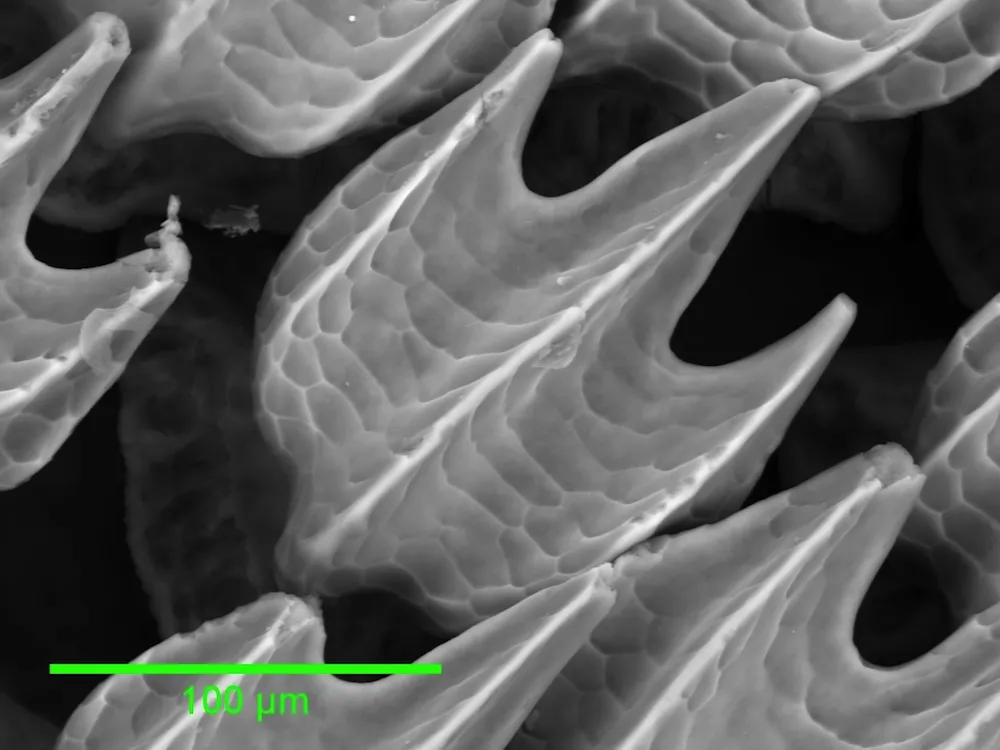
Shark skin may look smooth, but it's actually composed of microscopic toothlike scales, called denticles. These tiny bumps disrupt the flow of water as the animal swims, reducing drag, but scientists didn't know exactly how this happens. [Biomimicry: 7 Clever Technologies Inspired by Nature]
This is the first time that anyone has measured the swimming energy benefit of bumpy shark skin compared with smooth skin, said George Lauder, a biologist at Harvard University in Cambridge, Massachusetts, and co-author of the study published today (May 14) in the Journal of Experimental Biology.
Artificial skin
To understand why shark skin works so well, scientists would have to modify it. Since modifying real shark skin isn't possible, Lauder and his colleagues manufactured an artificial skin.
The researchers found a mako shark in a local fish market and took a high-resolution scan of its skin surface. By zooming in on a single denticle, the team was able to create a computer model of shark skin made of thousands of denticles.
Get the world’s most fascinating discoveries delivered straight to your inbox.
Creating the actual skin proved to be more difficult. The team used a 3D printer to embed artificial scales into a flexible membrane, spending a year trying different materials to find ones that worked. They used a scanning electron micrograph to image the fake skin.
Next, the researchers affixed the artificial skin to both sides of a flexible foil that was kept still or was made to flap like a swimming shark, and put it in a tank of flowing water.
Compared with the smooth foil alone, the foil with the artificial skin reduced drag by 8.7 percent at the lowest water flow speeds. At the highest flow speed, the fake skin actually produced 15 percent more drag than the smooth surface did standing still, but when the researchers flapped the foil like a fish 1.5 times per second, the shark skin improved swimming speed by 6.6 percent, using 5.9 percent less energy, results showed.
Next, the researchers aim to test how changing the arrangement of the denticles will affect swimming performance. But humans won't be wearing sharkskin swimsuits anytime soon, because they're too hard to manufacture, the researchers said.
Follow Tanya Lewis on Twitter and Google+. Follow us @livescience, Facebook & Google+. Original article on Live Science.
