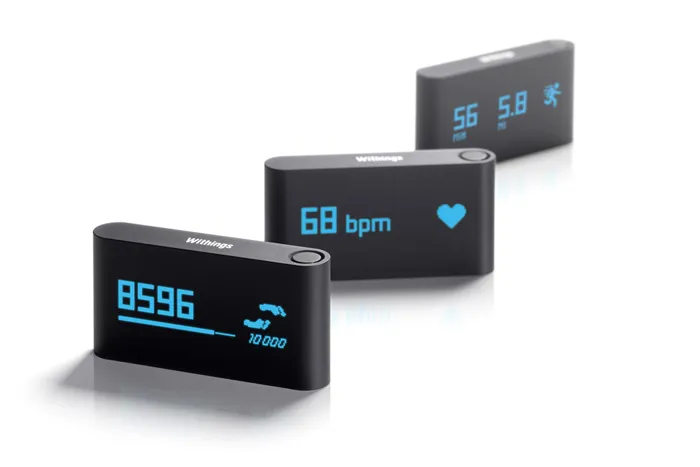
The Withings Pulse is an activity tracker that records your movements, calories burned and sleep time. What sets the Pulse apart from most fitness trackers is its inclusion of a heart-rate sensor, despite its small size.
The Pulse allows you to check your heart rate by putting your fingertip on the optical sensor on the back of the device. The sensor measures your heart rate by emitting light into your fingertip and calculating the changes in the blood's oxygen levels from the reflected light. In general, the heart rate is measured in beats per minute (bpm), and is normally between 60 and 100 bpm at rest.
Although the heart-rate information from the device shouldn't be used for medical purposes, knowing your heart rate has some advantages for your health. For example, your resting heart rate may tell you about your fitness.
During exercise, your heart rate reflects the intensity of your activity, so tracking it helps you know whether you are training efficiently. You can also measure your heart rate to see the effects of caffeine or some medications on your heart rate.
The Pulse is one of the most comfortable and smallest of all the devices with heart-rate monitoring I have tried, but it's the least practical. To get a recording, you need to take out the device from its wristband so you can put your finger on the back. This is not easy to do while you are exercising.
But are the heart-rate readings of the Pulse reliable? I compared it with both a chest-strap heart monitor and another wristband tracker that has a heart-rate monitor, to find out.
Withings Pulse vs. Polar Beat chest strap
Sign up for the Live Science daily newsletter now
Get the world’s most fascinating discoveries delivered straight to your inbox.
Here's how the Withings Pulse heart rate monitor compares to the Polar Beat heart monitor.
(Image credit: Jeremy Lips / Live Science)
The Polar Beat H7is a chest-strap monitor that wirelessly sends heart-rate readings to your phone. In general, chest straps are a reliable way to continuously measure the heart rate.
When comparing the Pulse's reading to those of the Polar Beat chest strap, I wasn't impressed with the Pulse but wasn't disappointed, either, especially given the simplicity of the device. The Pulse takes a long time to read the heart rate, and its readings are not always consistent with those of the chest strap but aren't that far off, either.
In general, the Pulse gives a good ballpark estimation of your heart rate — the question is whether it's worth removing the wristband to get a heart-rate reading every time.
Withings Pulse vs. Basis B1
Here's how the Withings Pulse heart rate monitor compares to the Basis heart rate monitor.
(Image credit: Jeremy Lips / Live Science)
The Basis is an activity tracker that measures your heart rate in your wrist, using light that shines into your tissue, similar to the way the Pulse works. But although the Pulse and the Basis use the same method to measure heart rate, it is difficult to compare the two, because the Pulse takes as long as half a minute to take the heart rate, and the Basis' display is not updated in real time — it doesn't always show your current heart rate.
When I did manage to get simultaneous readings, they were more or less in the same range. From a practicality standpoint, the Basis is more convenient because you don't have to move it to read your heart rate, but it's also bigger and doesn't measure your heart rate on demand.
Bahar Gholipour is a staff reporter for Live Science covering neuroscience, odd medical cases and all things health. She holds a Master of Science degree in neuroscience from the École Normale Supérieure (ENS) in Paris, and has done graduate-level work in science journalism at the State University of New York at Stony Brook. She has worked as a research assistant at the Laboratoire de Neurosciences Cognitives at ENS.