













Wild Chimps Prefer a Firm Bed

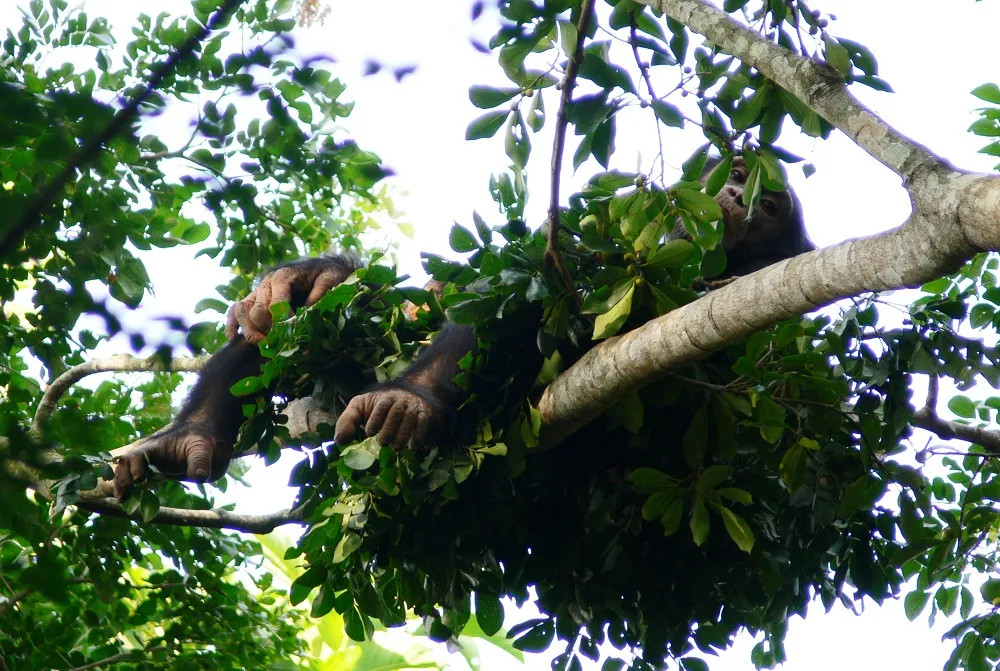
Chimpanzees are quite choosy when it comes to their sleeping arrangements, and new research suggests the apes prefer a firm bed made from stiff, resilient wood.
Like humans, chimpanzees depend on a good night's sleep to function well the next day, but chimps don't tuck themselves into the same bed each night. Instead, the primates build a new nest each evening, from scratch. High up in the forest canopy, the animals interlace strong stems and foliage into a basketweave, creating a thick, springy "mattress" that sinks in the middle.
Scientists have known that chimpanzees build these sleeping platforms since Jane Goodall famously studied the apes in Tanzania's Gombe Stream National Park in the 1960s. There seem to be several advantages to snoozing high off the forest floor. In 2011, one intrepid Cambridge researcher who slept in wild chimpanzee nests for six nights reported that the nests kept her warm and relatively free of bug bites; they also eased her worries about the hyenas she heard calling in the night. [Sleep Soundly: Images of Primate Nests]
And now, another group of researchers has looked at whether chimpanzees are picky about the type of wood they use for their nests. Anthropologists David Samson, of the University of Nevada, Las Vegas, and Kevin Hunt, of Indiana University, in Bloomington, examined 1,844 chimpanzee nests in western Uganda's Toro-Semliki Wildlife Reserve.
They found that 73.6 percent of the nests were built with the plant species Cynometra alexandri, despite the fact that this tree was hardly the most common species in the area, representing just 9.6 percent of the local arboreal population.
C. alexandri is known locally as "ironwood" because it is dense and resilient — properties that make it a popular construction material. Those same qualities seem to attract sleepy chimpanzees, the researchers wrote in their report published April 16 in the journal PLOS ONE.
Samson and Hunt's tests proved that C. alexandri was not only the stiffest, but also had the greatest bending strength of the seven trees most commonly used by the apes.
Get the world’s most fascinating discoveries delivered straight to your inbox.
Ugandan ironwood may have other advantages, too. With its small, densely packed leaves, branches of the tree may be more insulating and more comfortable to sleep on than the branches of other local tree species which can have sparse, protruding stems.
Ugandan ironwood might even keep bugs at bay. In a study published last year in the journal Primates, Samson and Hunt found that mosquitos were less likely to congregate around C. alexandri, which is thought to have repellant properties.
The results suggest that chimpanzees might consider several physical traits of trees when choosing their bedding, including "stiffness, strength and leaf surface area, and that they select species that provide the widest range of advantages, including predator avoidance, postural stability, thermoregulation and pathogen avoidance," the authors wrote.
Follow Megan Gannon on Twitter and Google+. Follow us @livescience, Facebook & Google+. Original article on Live Science.
