















New Insight into How Blood Clots
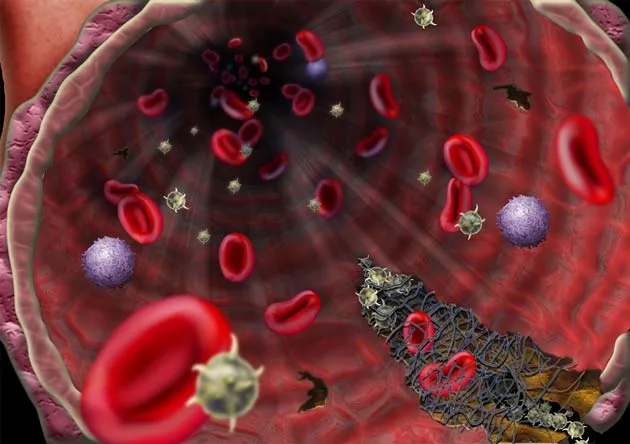
When you slice your finger while chopping celery, it requires more than 80 different chemical reactions to clot blood and stop the bleeding. But one false reaction, and the clot could form in the wrong spot and be deadly.
Clots sometimes form even when there's no wound to plug, and for years, scientists didn't understand the process or know how to tell when it might happen. Now researchers at the University of Chicago have developed a simple technique to predict the timing and location of blood clots.
"The really cool part was that our observations were actually predicted by an artificial model of clotting that represented the 80 reactions of clotting in just three simple chemical reactions," said Christian Kastrup, a University of Chicago chemistry graduate student and study coauthor.
| Mystery Monday |
Each Monday, this LiveScience series explores an amazing aspect of the world around you. |
- Champagne Bubble Mystery Solved
- Icicle Formation Mystery Solved
- Chasing Tornadoes
- Why We Itch
- Zit Myths Cleared Up
- How Planes Fly
- How People Walk on Fire
- Bad Breath: Causes and Cures
- The Real Scoop on Rumors and Gossip
- How Cacti Survive: Surprising Strategies Quench Thirst
The technique was detailed in the Oct. 16 online issue of the Proceedings of the National Academy of Sciences.
Elements in our blood—round platelets, which are produced in bone marrow—are constantly flowing through the blood stream on the lookout for leaks in blood vessels to plug. When they find a tear in need of repair, they become "sticky," and clump together.
Simultaneously, the thrombin system in the blood sets off a series of reactions that produces long, stretchy proteins. Individually, the fibrous proteins are the most flexible fibers in nature and can stretch up to three times their length, according to a recent study by scientists at Wake Forest University.
The proteins, called clotting factors, form a flexible net that catches the platelets and holds them in place to stop blood flow. As a whole net, they lose some of their flex, but not all.
Get the world’s most fascinating discoveries delivered straight to your inbox.
This net of protein and platelets is the scab you see on your skinned knee.
In the new study, Kastrup and his colleagues discovered that the placement of one of the clotting factors in the net, called tissue factor, plays a large role in determining whether platelets will clot.
"When we exposed blood to tissue factor that was localized to large patches on surfaces, clotting initiated," Kastrup told LiveScience. "In contrast, when blood was exposed to tissue factor that was spread out within the sample, clotting did not occur."
Because tissue factor clots blood only when there's a lot of it crowded around tissue patches of a certain size, scientists might be able to better predict clotting by monitoring a patient's tissue factor concentration. The method may someday be used as a diagnostic tool to prevent unwanted clotting.
When the platelets, clotting factors, and other chemicals don't work as a team, they can cause excessive bleeding or, conversely, block blood flow by clotting unnecessarily. Each year, 600,000 Americans die from abnormal blood clots, according to the National Hemophilia Foundation.
"Blood clotting is useful for stopping bleeding and tissue regeneration, but it is also related to a lot of diseases, like stroke and hemorrhage," said coauthor Feng Shen. "The inappropriate formation of blood clots around the heart or brain could be fatal. Predicting where and when a blood clot will occur could prevent patients from getting coagulation disease."
- Video: Cancer Curing Blood
- Synthetic Blood Vessels Not Such a Stretch
- Loss of Loved One Really Can Cause Broken Heart
- New Device Reveals Hidden Blood Vessels
- Scientists Create Tiniest Blood Vessels