A KC-130J Super Hercules carrying U.S. Marines from the 3rd Marine Expeditionary Brigade taxies toward the terminal with guidance from a Philippine airman at Villamor Air Base in the Philippines on Nov. 10, 2013. Marine Corps forces are working with the Philippine government to rapidly deliver humanitarian assistance and disaster relief in the wake of Typhoon Haiyan.
(Image credit: U.S. Marine Corps photo by Capt. Joshua Diddams)
The U.S. military is assisting with recovery efforts and humanitarian relief in the Philippines in the aftermath of Typhoon Haiyan, which caused devastating damage and is estimated to have killed more than 10,000 people.
Over the weekend, Defense Secretary Chuck Hagel directed the U.S. Pacific Command to help local search-and-rescue operations in the central Philippines, and provide air support to monitor the effects of Super Typhoon Haiyan, which battered the island nation when it made landfall last Thursday (Nov. 7).
The deadly typhoon (known as Typhoon Yolanda in the Philippines) reached super typhoon strength, and has become one of the largest Pacific storms ever recorded. It ravaged the coastal city of Tacloban with storm surge that reached up to 20 feet (6 meters) in places, whipped up by winds that were estimated at 195 mph (314 km/h) hours before landfall.
Local officials estimate 10,000 people may have been killed by the colossal storm. The United Nations, which is providing humanitarian assistance on the ground, estimates Haiyan has displaced 600,000 people across the country.
The U.S. Department of Defense is also working with the U.S. Agency for International Development, the U.S. ambassador in Manila and the Philippines government to ferry cargo and supplies to the communities hardest hit by the storm.
Yesterday, members of the U.S. Marine Corps' 3rd Marine Expeditionary Brigade touched down at the Villamor Air Base, home of the Philippine Air Force, in Pasay City.
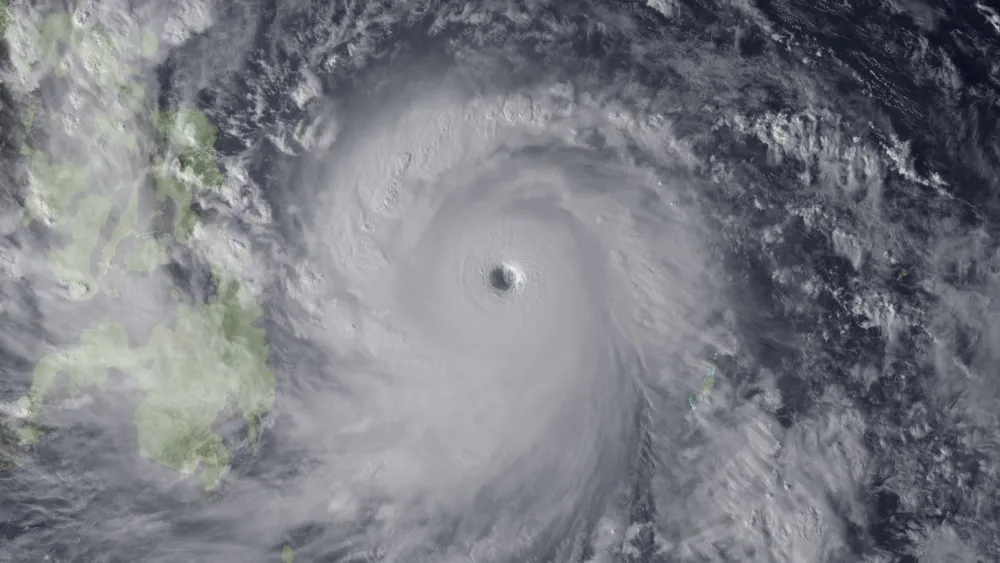
Super Typhoon Haiyan, the strongest storm seen in during the satellite era, was spotted by the Japan Meteorological Agency's MTSAT on Nov. 7, 2013, as it headed toward landfall over the Philippines.
(Image credit: Japan Meteorological Agency/NOAA)
Haiyan has weakened considerably since sweeping through the Philippines, but the storm is currently making landfall over Vietnam with sustained winds of 75 mph (120 km/h), approximately 100 miles (160 km) east of the Vietnamese capitol of Hanoi, according to the U.S. Joint Typhoon Warning Center, a U.S. Air Force and Navy task force based in Hawaii.
Sign up for the Live Science daily newsletter now
Get the world’s most fascinating discoveries delivered straight to your inbox.
Haiyan is the 11th typhoon to form in the western Pacific Ocean this year, and is the year's fifth super typhoon. In the Western Pacific, a tropical storm is classified as a typhoon when its wind speeds reach 74 mph (119 km/h). A storm becomes a super typhoon when its winds reach 150 mph (241 km/h), which is equivalent to a strong Category 4 or 5 hurricane in the Atlantic Ocean basin, according to the National Oceanic and Atmospheric Administration. Typhoons and hurricanes are the same phenomenon, but are called different things in different ocean basins.
Denise Chow was the assistant managing editor at Live Science before moving to NBC News as a science reporter, where she focuses on general science and climate change. Before joining the Live Science team in 2013, she spent two years as a staff writer for Space.com, writing about rocket launches and covering NASA's final three space shuttle missions. A Canadian transplant, Denise has a bachelor's degree from the University of Toronto, and a master's degree in journalism from New York University.