















Facts About Nobelium

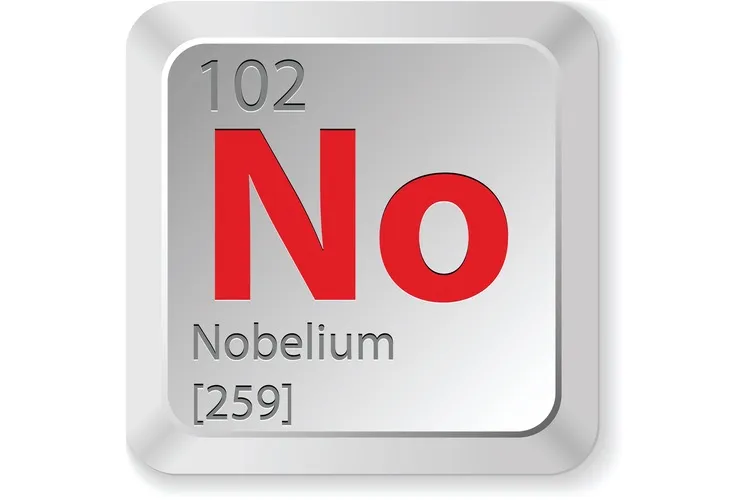
Atomic Number: 102 Atomic Symbol: No Atomic Weight: 259 Melting Point: 1,521 F (827 C) Boiling Point: Unknown
Word Origin: Nobelium is named after Alfred Nobel, the inventor of dynamite.
Discovery: The element was officially discovered in April 1958 in Berkeley, California, by Albert Ghiorso, Glenn Seaborg, Torbørn Sikkeland and John R. Walton. The year before, a team in Stockholm, Sweden, at the Nobel Institute of Physics announced a new element called nobelium that had a half-life of 10 minutes. That discovery could not be replicated, however, though labs in Berkeley and Dubna, Russia, attempted it. The Berkeley team produced an isotope, 254No, with a half-life of three seconds, and the Russians replicated that discovery. Credit for nobelium’s discovery was given to the Berkeley team, who decided to keep the name nobelium.
Properties of nobelium
Nobelium is a member of the actinide series and little is known about it. There are 10 recognized isotopes of nobelium. The most stable is 259No, which has a half-life of about 58 minutes. [See Periodic Table of the Elements]
Sources of nobelium
Nobelium is artificially produced, and it has never been made in great quantities. It can be produced through bombarding Curium-246 with Carbon-12 ions.
Get the world’s most fascinating discoveries delivered straight to your inbox.
Uses of nobelium
Because nobelium has only been produced in small quantities, its only use is within scientific research.
(Sources: Los Alamos National Laboratory, Jefferson Lab)
