













Facts About Actinium

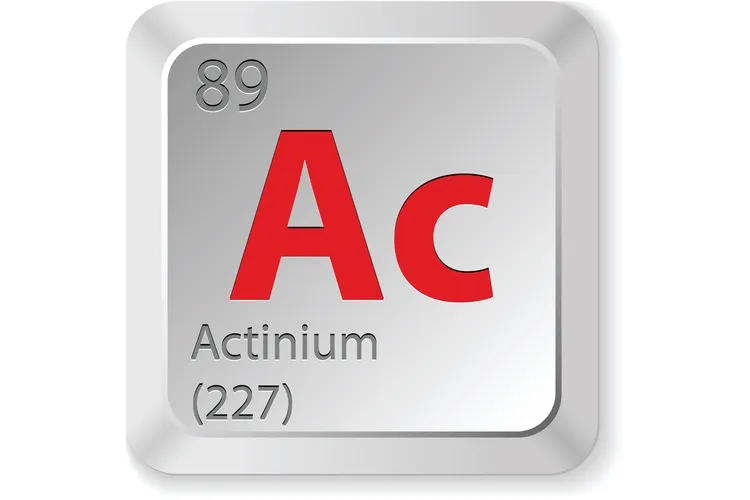
Atomic Number: 89 Atomic Symbol: Ac Atomic Weight: 227 Melting Point: 1,924 F (1,051 C) Boiling Point: 5,788 F (3,198 C)
Word origin: The word actinium comes from the Greek aktis or aktinos, which means beam or ray.
Discovery: Actinium has two independent discoverers: Andre Debierne, who found it in 1899, and F. Giesel, who discovered it in 1902.
Properties of actinium
Actinium is the first of the actinide series of elements. The chemical behavior of actinium is similar to rare earths, especially lanthanum. Actinium is about 150 times as active as radium. [See Periodic Table of the Elements]
Actinium has 36 isotopes, none of which are stable. Actinium occurs as isotope 227Ac in uranium decay.
Actinium has several decay products, including isotope 227Ac, a beta emitter that is a decay product of 2235U with a 21.6-year half-life. Other principle decay products are 227Th (which has an 18.5-day half-life), 223Ra (with a 11.4-day half-life), and a number of short-lived products like radon, polonium, bismuth, polonium, and lead isotopes. In equilibrium with its decay products, actinium is a powerful source of alpha particles. Purified actinium comes into equilibrium with its decay products after of 185 days, and then decays for a further 21.6-years, according to 227Ac’s half-life.
Get the world’s most fascinating discoveries delivered straight to your inbox.
Sources of actinium
Isotope 227Ac occurs naturally through the decay of uranium minerals. Actinium metal can been prepared by reducing actinium fluoride with lithium vapor at about 1,100 to 1,300 degrees C (2,012 to 2,372 F).
Uses of actinium
Actinium’s high activity level makes it valuable in producing neutrons. There has been some work done to use 225Ac in treating cancer patients.
(Source: Jefferson Lab
