














Strangely Shaped Dunes Stay Stable Through 'Birthing'

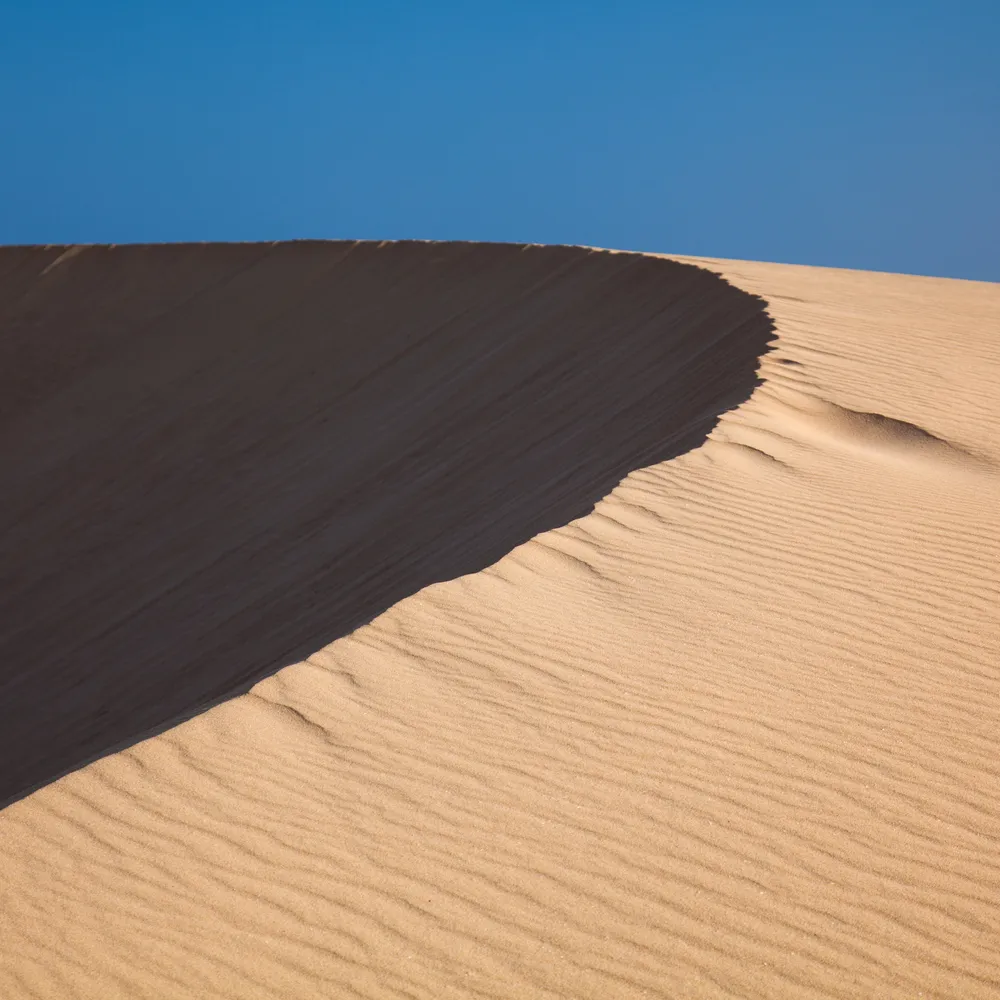
Giant clusters of crescent-shaped sand dunes found not just on Earth but on other planets in the solar system might emerge when large dunes give birth to smaller ones, researchers say.
Crescent-shaped dunes known as barchans sprawl across vast deserts everywhere from Morocco to Mars. Typically 3 to 30 feet (1 to 10 meters) high, they can be up to some 3,300 feet (1,000 m) long in the direction the wind blows. Barchans can form on the seafloor and on ice as well — indeed, anywhere fluid (like air or water) might flow across grains of matter (like sand) that rest on top of hard, flat surfaces.
Barchans rarely exist alone, "instead existing in vast empires occupying large fields," geomorphologist Stacey Worman at Duke University in Durham, N.C., told LiveScience's OurAmazingPlanet.
Despite the widespread nature and familiarity of these dunes, it remains unknown how such fields can exist in nature. Models that seek to explain how barchans develop and take on their crescent shape often predict that lone dunes below a certain size should shrink and disappear, while those above that size should grow without bound, a size dependent on the material the dunes and the fluid flowing on it are made of. In reality, vast swarms of barchans, all with similar and apparently stable sizes, can somehow persist. [World's Weirdest Geological Formations]
Birthing dunes
Past research suggested collections of barchans might emerge if the dunes repeatedly collided with each other, interactions where they exchanged matter and stabilized in size. Now scientists find another way such clusters might arise when large dunes birth or "calve" smaller dunes.
"We have a new potential explanation for why barchan dune fieldscan exist, and for why they're arranged and shaped the way they are," researcher Brad Murray, a Duke geomorphologist said in an interview.
Get the world’s most fascinating discoveries delivered straight to your inbox.
Murray explained how the idea came about: Theoretical physicists Bruno Andreotti and Philippe Claudin "spent a lot of time in the western Sahara making measurements of dunes over time and looking at satellite images of them over time. Based on all of that, they came up with the idea that perhaps after sand dunes got bigenough, they calved off smaller dunes that kept them from blowing up to infinite size. One sunny afternoon while sitting on a dune crest in the Sahara with them, they told me about their calving ideas, and we came up with the idea for a simple model of dunes interacting with each other."
Like ducks in formation
The research team's computer models suggest that when the crescent tips of large dunes calve smaller dunes, this influences neighboring dunes, altering the way sand is exchanged within a barchan field and helping dune sizes to be relatively stable. Their simulations also suggest these relatively simple interactions between individual dunes collectively lead to the spontaneous emergence of previously enigmatic patterns within dune fields, such as the sections of bare ground cropping up between clusters of dunes "and isolated patches of dunes that resemble ducks flying in migration," Worman said.
Murray cautioned that their model was currently a simplified version of what might be going on in nature.
"While this model shows calving provides a plausible explanation for the existence and characteristics of dune fields, that doesn't prove it's the right answer," Murray said. "A lot more steps are needed to test the model against observations with higher levels of detail to see if it actually matches what goes on in the real world."
The scientists detailed their findings online Aug. 12 in the journal Geology.
Follow OurAmazingPlanet @OAPlanet, Facebook and Google+. Original article at LiveScience's OurAmazingPlanet.
