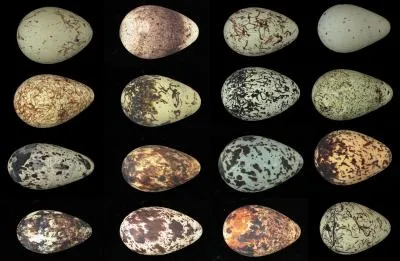
Unlike birds that incubate their young in carefully built nests, sea-loving guillemots lay their eggs in rather precarious places — on rock ledges and exposed cliffs in crowded breeding colonies throughout the North Atlantic and North Pacific Oceans.
The bottom-heavy shape of guillemot eggs prevents them from tumbling off cliffs: When the eggs get knocked over, they spin in a tight circle. New research shows that guillemots also have tiny structures on their eggshells that keep the eggs from falling and help them stay clean.
"This work was started by accident," Steven Portugal, a researcher at the University of London's Royal Veterinary College, explained in a statement.
When water was accidentally spilled on a collection of guillemot eggs, Portugal noticed that the droplets behaved strangely on the surface of the shells. [In Photos: The Life of a Shorebird]
"The water droplets stayed as a sphere on the eggs, typically an indication of a hydrophobic surface," Portugal said.
Portugal and colleagues examined the eggshells of more than 400 other bird species. They found the eggshells of guillemots, also called murres, had unique cone-like nanostructures that made them quite resilient.
The guillemot eggshells have hierarchical cone nano-structures that enable them to survive precarious habitats, on exposed cliffs with no nest.
(Image credit: Steven Portugal and Golo Maurer)
Compared with the eggs of other birds, guillemot eggshells had a higher water contact angle, which is the angle between a surface and the top of a water droplet as it beads up. If a material has a high water contact angle, water hitting its surface will make a round bead that's more likely to roll off than be absorbed. For guillemot eggs, this feature helps the eggshells stay clean, with rolling water droplets washing off salt and feces, the researchers said.
Sign up for the Live Science daily newsletter now
Get the world’s most fascinating discoveries delivered straight to your inbox.
The eggs also had a high rate of gaseous exchange that allowed them to deal with exposure to salt from sea spray. What's more, the eggs had a rougher surface than most other bird eggs, which helped keep them from falling off cliffs or rolling away from their parents' feet.
The nanostructures in guillemot eggshells might stand out among birds, but similar hydrophobic, or water-resistant, designs have been found elsewhere in nature, such as the lotus leaf. Manufacturers have mimicked these natural structures to make water-resistant materials, and the researchers say their finding among guillemot eggshells could inspire some new designs.
The research was to be presented today (July 5) at the meeting of the Society for Experimental Biology in Valencia, Spain.
Megan has been writing for Live Science and Space.com since 2012. Her interests range from archaeology to space exploration, and she has a bachelor's degree in English and art history from New York University. Megan spent two years as a reporter on the national desk at NewsCore. She has watched dinosaur auctions, witnessed rocket launches, licked ancient pottery sherds in Cyprus and flown in zero gravity. Follow her on Twitter and Google+.