














To Repel Water, Spray Coating Mimics Lotus Leaf
This Research in Action article was provided to LiveScience in partnership with the National Science Foundation.
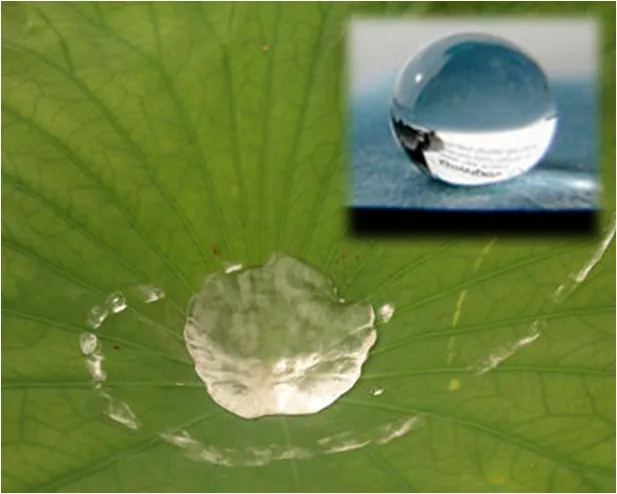
Imagine a coating that causes water to bead into almost perfect spheres, to enable any surface to mimic the incredible water repellant properties of the lotus leaf. California-based Seashell Technology, a National Science Foundation Small Business Innovation Research program grantee has developed a sprayable coating that does just that.
The extreme water repellency is due, in part, to roughness at the nanoscale and microscale levels — which is created as the coating cures — as with a lotus leaf, each water droplet sits on top of minuscule surface bumps. Formulated to work with a variety of substrates, the company's Hydrobead coating provides weather resistance and anti-icing performance.
This kind of superhydrophobic, or incredibly water resistant, coating is characterized by quantifying the degree to which water will bead on a surface. This is measured by placing a drop of water on a surface and measuring the angle between the surface and the edge of the water droplet. This angle is called the water contact angle.
For angles close to 0 degrees, the surface is considered hydrophilic; as the contact angle increases to greater than 90 degrees, the surface is considered hydrophobic. For flat, smooth surfaces, the water contact angle maxes out at approximately 120 degrees, which is typical for fluorinated surfaces such as Teflon or other compounds.
Compared to those coatings, the Hydrobead coating has a water contact angle greater than 150 degrees.
Seashell Technology's coatings have also been characterized for anti-ice behavior — because of their special water repellant properties, they inhibit the buildup of ice crystals on surfaces. In general, the anti-ice properties of the coating can be determined by measuring the force required to remove ice frozen on a surface.
Get the world’s most fascinating discoveries delivered straight to your inbox.
More information can be found at hydro-bead.com.
Editor's Note: Any opinions, findings, and conclusions or recommendations expressed in this material are those of the author and do not necessarily reflect the views of the National Science Foundation. See the Research in Action archive.