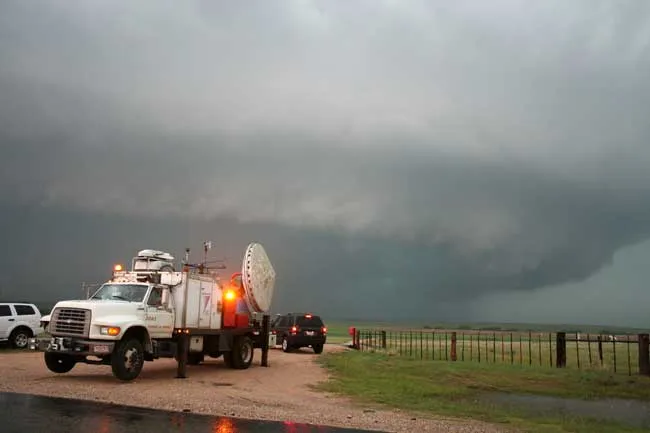
An unprecedented $10.5 million dollar effort to understand tornadoes will send dozens of scientists into the field next month to chase the killer beasts.
Researchers from four countries and 19 universities and institutions will fan out and chase tornadoes across South Dakota, western Iowa, eastern Colorado, Nebraska, Kansas, the Texas panhandle and western Oklahoma.
The blitz will run May 10 to June 13.
Latest Videos FromLive Science
Though tornado basics are understood — they generally form when warm and cold air masses clash — exactly under what conditions they develop, and what goes on inside one, remains elusive. Improved understanding would help scientists better predict when and where they will strike, the scientists said in a statement today.
The project, VORTEX2 (V2), will be the largest attempt in history to study tornadoes, and will involve more than 50 scientists and 40 research vehicles, including 10 mobile radars.
The quarry: super-cell thunderstorms that generate the biggest and most destructive tornadoes.
Verification Of Rotation in Tornadoes EXperiment 2 (VORTEX2) is funded by the National Science Foundation (NSF) and the National Oceanic and Atmospheric Administration (NOAA).
"An important finding from the original VORTEX experiment was that tornadoes happen on smaller time and space scales than scientists had thought," said Stephan Nelson, NSF program director for physical and dynamic meteorology. "New advances from VORTEX2 will allow for a more detailed sampling of a storm's wind, temperature and moisture environment, and lead to a better understanding of why tornadoes form--and how they can be more accurately predicted."
- Video: Team Tornado Chases the Beast
- Tornado News & Information
- Gallery: Tornadoes