






How Hot Is Lava?
Get the world’s most fascinating discoveries delivered straight to your inbox.
You are now subscribed
Your newsletter sign-up was successful
Want to add more newsletters?
Delivered Daily
Daily Newsletter
Sign up for the latest discoveries, groundbreaking research and fascinating breakthroughs that impact you and the wider world direct to your inbox.
Once a week
Life's Little Mysteries
Feed your curiosity with an exclusive mystery every week, solved with science and delivered direct to your inbox before it's seen anywhere else.
Once a week
How It Works
Sign up to our free science & technology newsletter for your weekly fix of fascinating articles, quick quizzes, amazing images, and more
Delivered daily
Space.com Newsletter
Breaking space news, the latest updates on rocket launches, skywatching events and more!
Once a month
Watch This Space
Sign up to our monthly entertainment newsletter to keep up with all our coverage of the latest sci-fi and space movies, tv shows, games and books.
Once a week
Night Sky This Week
Discover this week's must-see night sky events, moon phases, and stunning astrophotos. Sign up for our skywatching newsletter and explore the universe with us!
Join the club
Get full access to premium articles, exclusive features and a growing list of member rewards.
Ice melts at 32 degrees Fahrenheit. Chocolate melts at 90 F. But rock? Now we're talking a lot more heat.
Lava, the melted rock that shoots out of volcanoes, can flow at temperatures of thousands of degrees Fahrenheit.
Lava that's on the cooler side comes out of volcanoes at only pizza oven-like temperatures of 570 F, according to the United States Geological Survey (USGS).
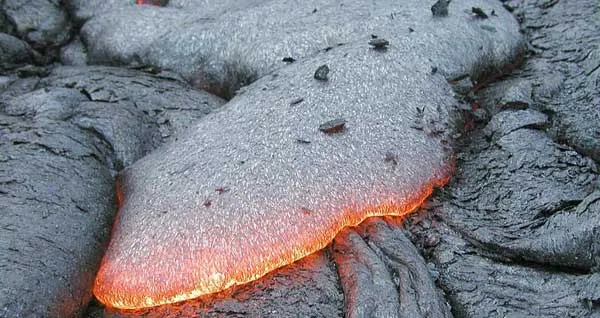
In the middle range of lava temperatures, the dark red lava often seen slowly crawling across parts of Hawaii , measures around 895 F. Mount St. Helens ejected material of a similar temperature, although this material flew from the mountain at 100 mph, according to USGS.
However, once a volcano gets going, the mercury really starts to climb. Bright red lava flows in Hawaii can get as hot as 1,165 F, with the glowing orange flows getting hotter than 1,600 F, according to USGS.
And when rock is seriously melting, such as the magma within the Hawaiian volcano of Kilauea , it can reach 2,120 F, according to USGS.
Get the world’s most fascinating discoveries delivered straight to your inbox.
