














Does Washing Fruits and Vegetables Make Them Safe?
Can it wash away Salmonella or E. coli?
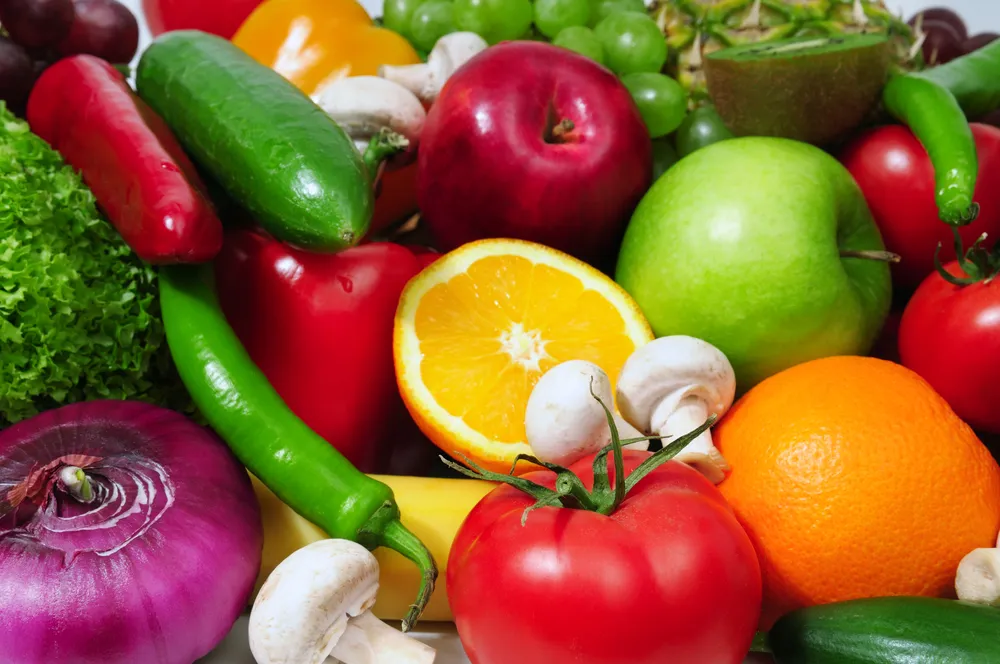
Washing fruits and vegetables is smart. But can it keep you safe from bacteria outbreaks like the recent tomato scare?
While rinsing a tomato under cold water rids the produce of a lot of potentially harmful bacteria, some of these tiny critters are resistant to the shower. Basically, they hang on tight, experts say.
The result can be outbreaks of Salmonella or E. coli in humans, even if we're careful.
Related: How do pineapples grow?
The FDA estimates 383 current Salmonella cases linked to contaminated tomatoes across 30 states, including Washington, D.C., since April 10 when the earliest known victim was reported. The outbreak is blamed on Salmonella serotype Saintpaul, an uncommon type of Salmonella, which are bacteria that can live in the intestinal tracts of humans and other animals. There are hundreds of types.
"As of right now, the FDA hasn’t been able to identify exactly where the tomatoes came from," said Brendan Niemira of the USDA's Microbial Food Safety Unit in Pennsylvania.
Even so, tomatoes can pick up such a pathogen from contaminated soil, irrigation water, manure, wildlife or farm workers.
Get the world’s most fascinating discoveries delivered straight to your inbox.
"If you've got bacteria on the surface of fruits and vegetables, and you give them a wash with cold water, it removes some of what's on the surface," Niemira told Live Science. "Unfortunately, it [cold water rinsing] doesn't remove all of them, and that's a problem. If things are well attached or living in a tight-knit community called a biofilm, that's going to be hard to get rid of."
Rough surfaces, like those on cantaloupes and spinach, provide lots of nooks and crannies in which bacteria can hide out, Niemira said. Tomatoes are much smoother, though their surfaces do contain tiny pores that make homes for bacteria.
You would want to wash rougher-surfaced fruit more carefully. Niemira cautions, however, too rough of a cleaning can bruise or tear the protective layer covering tomatoes and other fruits and vegetables.
Damage to the produce can lead to spoilage, and the associated "spoilage bacteria." While these bacteria aren't harmful to humans, the organisms make produce mushy and provide more hangouts for human pathogens, such as Salmonella, Niemira explained. "The spoilage bacteria don't hurt people; they start to digest the tomatoes and you get a little bit of spoilage and weeping," Niemira said. "That releases sugars and other things that can support the growth of pathogens. If you do have some pathogens on there, and you do have some spoilage, that can lead to an outgrowth [of the pathogens]."
The FDA does not recommend washing fruits and veggies with soap, detergent, bleach or commercial produce washes.
For safe measure, here are some tips to help keep produce safe:
- Handle produce with care to minimize bruising.
- Wash in cold water.
- Dry off any excess water.
- Keep produce that is supposed to be kept cool in the refrigerator (The FDA recommends a fridge setting of 40 degrees F or below).
- Get rid of fruits and vegetables that look as if they are going bad.
Though we work to rid our foods of pesky E. coli and Salmonella, our bodies are covered in bacteria. In fact, many bacteria help us carry out daily functioning, such as digesting food and even keeping harmful bacteria from taking a foothold on our skin.
Originally published on Live Science.
Jeanna Bryner is managing editor of Scientific American. Previously she was editor in chief of Live Science and, prior to that, an editor at Scholastic's Science World magazine. Bryner has an English degree from Salisbury University, a master's degree in biogeochemistry and environmental sciences from the University of Maryland and a graduate science journalism degree from New York University. She has worked as a biologist in Florida, where she monitored wetlands and did field surveys for endangered species, including the gorgeous Florida Scrub Jay. She also received an ocean sciences journalism fellowship from the Woods Hole Oceanographic Institution. She is a firm believer that science is for everyone and that just about everything can be viewed through the lens of science.