
















It Ain't Over Yet: New Storm Brews in Atlantic

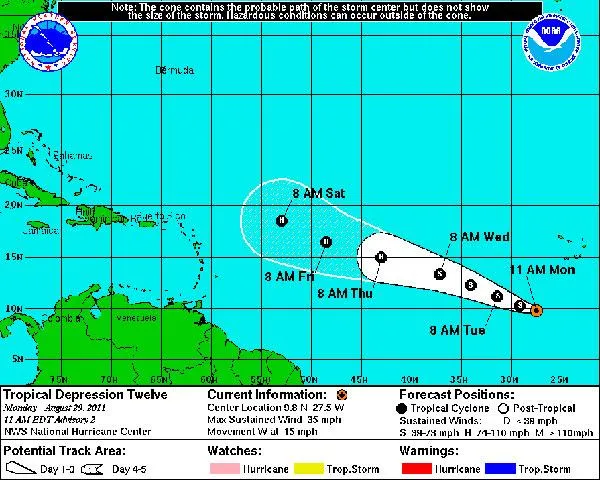
Irene may be nothing more than a remnant low-pressure system over Arctic waters, but hurricane season is far from over. Tropical Depression 12 has formed in the eastern Atlantic and is poised to become Hurricane Katia, with a track taking it toward the Caribbean.
Communities along the Eastern Seaboard are cleaning up from Irene's fierce winds and relentless rains , which caused major flooding in many areas. Meanwhile, out over the Atlantic Ocean, the atmosphere is continuing to churn up more storms.
The remnants of Tropical Storm Jose, which formed over the weekend, are dissipating south of Nova Scotia, and now Tropical Depression 12 has formed off the west coast of Africa.
This new tropical system is about 405 miles (650 kilometers) south-southwest of the southernmost Cape Verde Islands and has winds of 35 mph (55 kph), according to the most recent advisory from the National Hurricane Center.
The budding storm is expected to blossom into a tropical storm, possibly as early as tonight, and eventually into a hurricane. When it becomes a tropical storm, it will be given the name Katia, the name that replaced Katrina after it was retired for the massive devastation it wrought on New Orleans and the Gulf Coast. [See satellite images of Katrina's aftermath .]
Currently, Tropical Depression 12 is not a threat to any land, and isn't expected to pose one for at least the next five days. Over this period, though, the system is projected to possibly strengthen into a Category 2 hurricane.
Whether or not the future Katia has an impact on the Caribbean will depend on other patterns in the atmosphere, as these can alter the path of a hurricane some storms continue straight on, while others curve back out to sea.
Get the world’s most fascinating discoveries delivered straight to your inbox.
If and when Katia does become a hurricane, it will be the second of the 2011 Atlantic season (Irene was the first), which has been projected to be a doozy. The National Oceanic and Atmospheric Administration updated its forecast on Aug. 4, predicting 14 to 19 named storms (which include tropical storms and hurricanes), seven to 10 hurricanes and three to five major hurricanes. An average Atlantic hurricane season will see 11 named storms, six hurricanes and two major hurricanes. August through October are the peak months of the Atlantic hurricane season.
- History of Destruction: 8 Great Hurricanes
- Infographic: Storm Season! How, When & Where Hurricanes Form
- Storm Targets: Where the Hurricanes Hit

Andrea Thompson is an associate editor at Scientific American, where she covers sustainability, energy and the environment. Prior to that, she was a senior writer covering climate science at Climate Central and a reporter and editor at Live Science, where she primarily covered Earth science and the environment. She holds a graduate degree in science health and environmental reporting from New York University, as well as a bachelor of science and and masters of science in atmospheric chemistry from the Georgia Institute of Technology.