














Fickle Aral Sea Sees Some Recovery

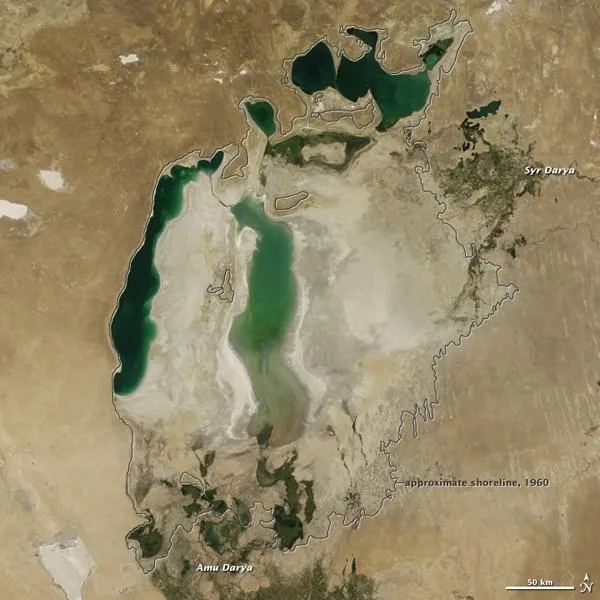
The size of the Aral Sea has long hinged on the Amu Darya, which flows from the high Pamir Mountains in central Asia, across the desert, and into the southern sea. While two rivers empty into the lakethe Amu Darya and the Syr Daryathe Amu Darya is the largest and most fickle source of water. At times in ancient history, the river has bent its course to empty into the Caspian Sea, and the abandoned Aral Sea shrank. The Aral Sea has been at its largest when the Amu Darya feeds it.
Modern trends are no exception: when water began to be diverted from the Amu Darya for vast agricultural projects starting in 1960, the Aral Sea began to shrink . This image, taken on August 26, 2010, by the Moderate Resolution Imaging Spectroradiometer (MODIS) on NASA's Terra satellite, demonstrates the close connection between the Aral Sea and the Amu Darya River. It is the most recent image in a ten-year sequence published on the Earth Observatory's World of Change: Shrinking Aral Sea.
Between 2000 and 2009, the Aral Sea steadily shrank. In 2006, severe drought settled in over Amu Darya Basin. Very little water reached the Aral Sea in 2007, and nothing flowed from the Amu Darya to the Aral Sea in 2008 and 2009, says Philip Micklin, a geographer from Western Michigan University who has been monitoring the Aral Sea for many years. Without water from the Amu Darya, the southern Aral Sea rapidly dwindled, the eastern lobe all but disappearing in 2009.
In 2010, however, the drought broke. Snow in the Pamir Mountains was normal, and enough water flowed into the Amu Darya that the river reached the Aral Sea. The muddy pulse of water settled in a shallow layer over the bed of the eastern lobe of the South Aral Sea, making it look much larger than it had in 2009.
Before 1960, the Aral Sea was the fourth largest lake in the world. However, much of the Amu Darya and Syr Darya have been diverted for agriculture, limiting the flow of water into the sea. Since 1960, the Aral Sea has lost 88 percent of its surface area and 92 percent of its water volume, says Micklin.
- The Heart of the Shrinking Aral Sea
- Meandering River Marks Alexander the Great's Northernmost Reach
- In Images: Mysterious Night-Shining Clouds
Get the world’s most fascinating discoveries delivered straight to your inbox.
