














Basking Sharks Declared a 'Species of Concern'

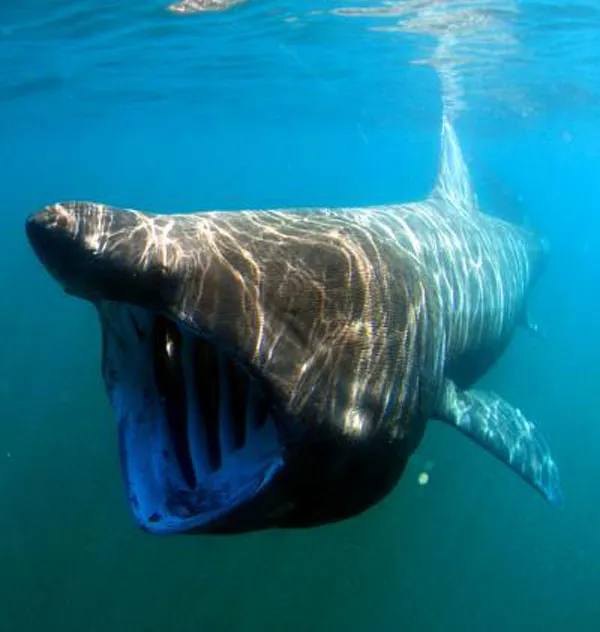
A population of basking sharks in the Pacific Ocean have been declared a "species of concern" by the National Oceanic and Atmospheric Administration's (NOAA) Fisheries Service due to steep declines in its population numbers.
The basking shark population has been dwindling despite a decrease in fishing in the past few decades, the agency said in an announcement on Wednesday.
Basking sharks are filter feeders, meaning they eat by straining food particles from water. They can be found throughout the world's oceans from the tropics and the Arctic. The sharks are most commonly found in temperate coastal waters where currents converge and plankton, their main source of food, is concentrated.
Until the 1950s the sharks were targeted for use in fishmeal and fish oil, and until the 1970s, fishermen continued to catch them as part of an eradication program to reduce run-ins between the sharks and fishing nets.
Today, scientists are worried about the eastern North Pacific population of basking sharks, whose numbers have not rebounded, even though fisherman are no longer pursuing them. While hundreds, and even thousands, of fish were once observed together, no group with more than three has been seen since 1993.
The label "species of concern" may be given to a species when there are concerns regarding the population status. The eastern Pacific basking shark is a species of concern, because it has been overfished and its population has not responded to conservation measures intended to help increase shark numbers.
The Fisheries Service hopes that by identifying it as a species of concern they can raise public awareness of the species status, generate interest in research to identify the factors that are inhibiting its recovery and, with states and other partners, restore this population before listing under the Endangered Species Act becomes necessary.
Get the world’s most fascinating discoveries delivered straight to your inbox.
Currently, in the United States' federal waters, sharks caught as bycatch must be released immediately, and the state of California has banned keeping caught basking sharks. In Canada, the Species at Risk Act makes it illegal to take, harass, or destroy habitat for basking sharks there. The species is also listed as endangered on the International Union for the Conservation of Nature (IUCN) Red List.
- On the Brink: A Gallery of Wild Sharks
- People More Dangerous Than Sharks
- 10 Species You Can Kiss Goodbye
