Bees Learn Thievery

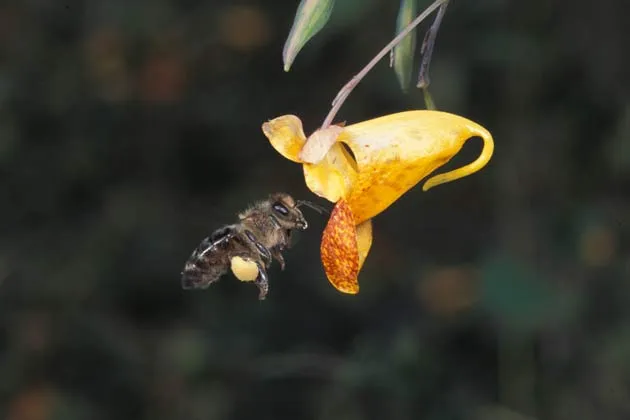
Even the pinhead-sized brains of insects can learn new skills from their comrades — including theft.
It seems bumblebees can discover how to "rob" flowers of nectar, scientists now reveal.
Normally bumblebees crawl into flowers to get nectar. In return for this sweet treat, blossoms coat the insects in pollen, which contains plant sperm. When these bees rendezvous with other flowers, they serve as couriers of this pollen, helping the plants breed.
However, bees can bite through the base of a flower to suck up nectar instead, avoiding the pollen altogether. Since they get something for nothing this way — drinking nectar without helping the flowers mate — such behavior can be seen as theft. The bees may commit such an act to get nectar from blossoms they could not fit into, or just to get more nectar than possible by normal means.
Now it appears that bumblebees can quickly learn how to rob flowers if they visit blossoms that others have already burglarized. The bees could learn how to commit such theft by themselves, but this was rare. But, after one bee learned how to rob nectar by watching its comrades, the skill rapidly spread to other bees.
It was long known that bees could learn simple facts from each other — such as where food is, for instance — but the discovery that insects can learn skills from others is a first.
"It was actually first suggested in one of Darwin's journals. He saw bumblebees robbing flowers in a garden one day, and saw honeybees doing something similar afterward," said researcher Ellouise Leadbeater, a behavioral ecologist at Queen Mary, University of London. "That led us to our work."
Get the world’s most fascinating discoveries delivered straight to your inbox.
The brains of bumblebees are a little larger than 1 cubic millimeter in size, or nearly one-millionth the size of a human brain.
"It's interesting to see what you can do with a small brain," Leadbeater told LiveScience. "But then again, it may be that you just don't need to be very clever to learn a simple technique like this."
In the future, research could see if bumblebees could teach other species of bees how to rob nectar. Other insects that could learn skills from within or outside their species might include ants, Leadbeater speculated.
Leadbeater and her colleague Lars Chittka detailed their findings online April 23 in the journal Proceedings of the Royal Society B.
- Video: Bees Scare Elephants
- 10 Amazing Things You Didn't Know about Animals
- Video: Wasps Trained to be Hounds