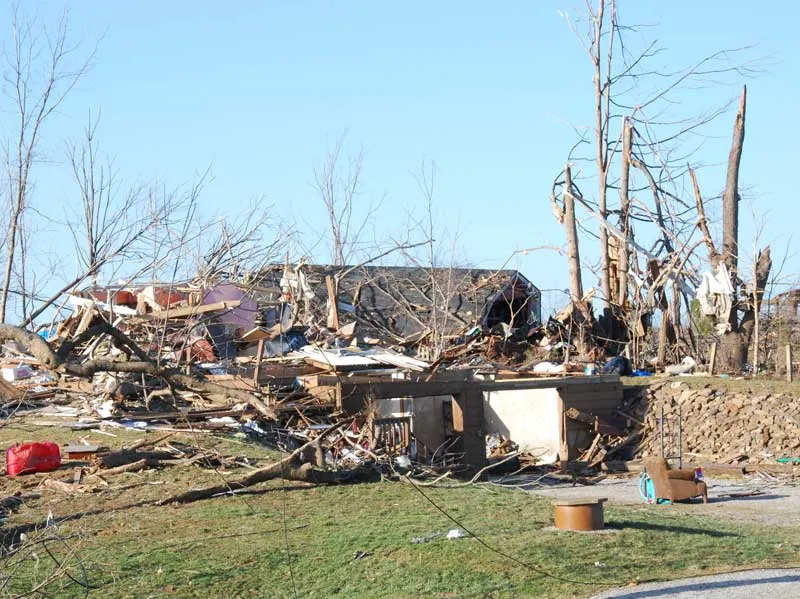
Tornado damage in Henryville, Ind., after a tornado swept through the small community on March 2, 2012. There have been fewer tornadoes this year than most.
Tornado season got off to a record start this year, with more twisters by mid-April than ever seen for that period since records began in 1950. After May, though, the number of tornadoes dropped off to a historic low. So far this year the United States has had only 888 tornadoes; last year, there were 1,691, according to the National Oceanographic and Atmospheric Administration.
"We are approaching a theoretical minimum in the annual tornado count for the modern era," Greg Carbin, a meteorologist at the National Weather Service Storm Prediction Center in Norman, Okla., told the Washington Post.
This year could set the record for fewest tornadoes, said Bob Henson, a meteorologist and science writer for the University Corporation for Atmospheric Research, in Boulder, Colo. With only six weeks left in the year, a flurry of activity that would cause a rise in the historic rankings is unlikely, Henson told OurAmazingPlanet. November and December are the third and fourth least-active months of the year for tornadoes, with a combined average of 70 to 80, according to the Washington Post.
The tornado drought has broken some records already. July, for example, was an extremely tornado-starved month, with only 37 twisters, according to NOAA. This beat the previous low of 42 tornadoes set in July 1960. There also haven't been any tornadoes this month, which is unusual, Henson said.
Why so few twisters?
The reason for the lack of tornadoes is the drought that gripped much of the country this summer and early fall, Henson said. Part of the reason for the drought — and hence the lack of tornado-producing storms — was the presence of a high-pressure "heat dome" over much of the country.
This heat dome began forming in mid-April and pushed the jet stream north into Canada, Carbin told the Post. That led to less precipitation and fewer thunderstorms in the United States — thus fewer tornadoes, which Henson noted can form only in these storms.
Sign up for the Live Science daily newsletter now
Get the world’s most fascinating discoveries delivered straight to your inbox.
A significantly greater number of tornadoes are recorded now than in decades past due to the increased number of storm chasers and the ease of sharing photos or video of twisters. Researchers have created "inflation-adjusted" stats that reflect how many tornadoes likely occurred in years past. Still, 2012 is on pace to be historic.
"It looks like we are close to having the quietest year for tornadoes on record, [even] when you adjust for inflation," Henson said.
The year with the fewest tornadoes was 1987, when only 1,013 tornadoes were reported, according to USA Today.
As this chart shows, the year got off to a record start for tornadoes, before falling off to a record low.
Douglas Main loves the weird and wonderful world of science, digging into amazing Planet Earth discoveries and wacky animal findings (from marsupials mating themselves to death to zombie worms to tear-drinking butterflies) for Live Science. Follow Doug on Google+.