















Kelp Forests Wired to Track Climate Change

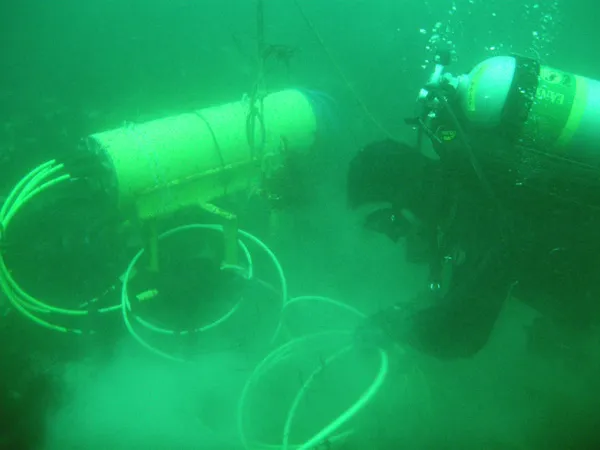
Climate researchers in California have brought their lab under the sea. They've wired kelp forests in Monterey Bay to send real-time data on the coastal ecosystem back to shore.
The newly established Kelp Forest Array has a suite of underwater instruments that can support experiments and supply scientists with a constant flow of information on climate change variables, such as the water's temperature, salinity, pH and oxygen and carbon dioxide levels.
"Instead of bringing the animals or the chemistry into the lab, we have taken the lab out into the field," Brock Woodson, a Stanford researcher who spearheaded the project, said in a statement.
But unlike battery-powered arrays that store their information underwater, the Kelp Forest Array has a direct line of communication to researchers on land via a broadband cable. Besides providing real-time information, this hook-up means that researchers are immediately notified if a system fails.
"It's a common experience," Jeffrey Koseff, director of the Stanford Woods Institute for the Environment, said in a statement. "You place instruments out there, come back several weeks later, and find that they had failed after just three hours."
The researchers say the array also can generate lots of information — about 1 gigabyte per hour.
"The amount of data we're collecting is pretty mind-boggling," Woodson said.
Get the world’s most fascinating discoveries delivered straight to your inbox.
In the array's first experiment, completed in August, researchers observed the fluid mechanics of internal waves — the kind that break underwater when cold, deep-ocean water meets warmer surface water. Another study in preparation will use the array to investigate the effects of ocean acidification on organisms without taking them out of their natural environment.
The researchers say an underwater camera in the array could soon provide an online live video feed of the bay's tall and dense kelp forests that support a diversity of colorful sea creatures.
"It's not unlike being in a redwood forest onshore," said Woodson.
Follow LiveScience on Twitter @livescience. We're also on Facebook & Google+.
