













Sticky Feet Help Robots Land on Asteroids

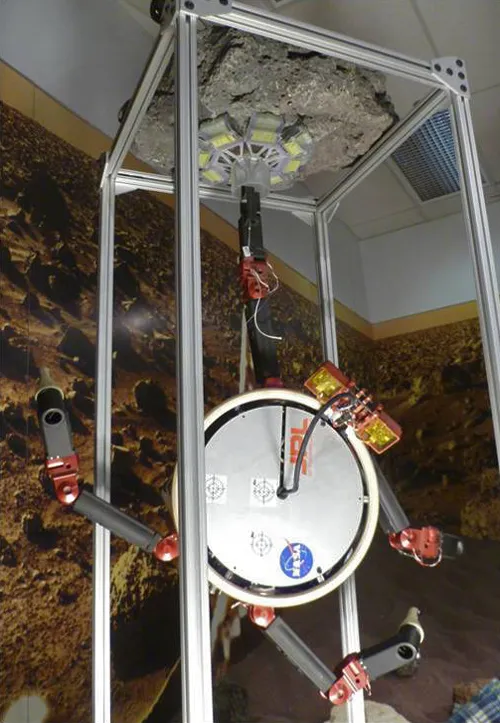
A new biologically-inspired robot could one day crawl over the surface of an asteroid or Mars and gather samples for study using lots of tiny, mechanical "toes." Aaron Parness, a robotics researcher at the Jet Propulsion Laboratory in Pasadena, California, presented his gripper May 16 at the Institute for Electrical and Electronics Engineers (IEEE) annual robotics conference, IEEE's Spectrum magazine reported.
NASA and other countries' space agencies have sent several missions to observe asteroids. So far, however, NASA spacecraft haven't directly gathered samples from an asteroid. Parness' robotic feet would allow asteroid probes to cling to the surface of even small asteroids, whose weaker gravitational pull might put a traditional rolling or walking probe at risk of "accidentally jettisoning itself into space," Parness wrote in a paper. A future Mars or other planetary mission might also use a sticky-footed robot to scale cliffs, Parness wrote.
One of the robotic feet Parness created consists of 16 fat, stubby toes arranged in a circle. Each toe has 12 "microspines," tiny steel hooks attached to a flexible suspension system. When the foot drags its microspines over the slightly rough surface of a rock, the hooks can attach to small dips or protrusions on the rock surface.
Parness' tests showed his robotic feet can resist more than 100 Newtons, a unit of force. They could probably resist more, he wrote, but right now, the test consists of having someone use a robot foot to pick rocks up from the ground, so he's limited by the strongest person he can recruit to help. He's working on creating a machine to test heavier rocks, he wrote.
He also found the foot can hold a drill to a basalt rock, boring out a sample half an inch (12 millimeters) in diameter which, during a mission, a probe could analyze or send back to Earth. The gripping drill works in several positions, including upside down and sticking straight out the side of the rock.
Watch the feet at work in a video Parness made:
Next, Parness will add feet like this to an 18-pound (eight-kilogram), four-limbed robot called the Lemur IIb, then test the Lemur's rock-climbing abilities in caves on Earth.
Get the world’s most fascinating discoveries delivered straight to your inbox.
This story was provided by InnovationNewsDaily, a sister site to LiveScience. Follow InnovationNewsDaily on Twitter @News_Innovation, or on Facebook.
