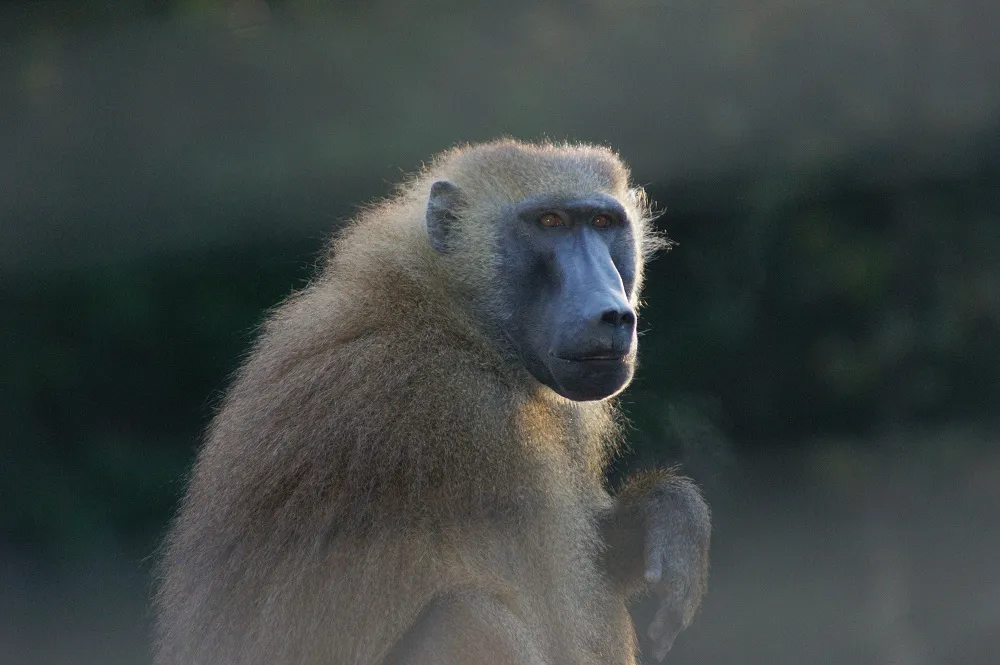
Baboons can master one of the basic elements of reading, although they have no linguistic skills, a French team reports. The monkeys in this study learned how to tell the difference between printed sequences of letters that made up actual English words and other, nonsense sequences.
Baboons can master one of the basic elements of reading even though they have no linguistic skills, a new study suggests.
Baboons in the study were able to differentiate between words and nonsense sequences of letters, even sometimes when they had never seen the words before, researchers reported.
"We wanted to know whether they could actually master this task, which is quite complex," study researcher Jonathan Grainger, of Aix-Marseille University in France, told LiveScience. "Our baboon specialist thought this was going to be impossible."
Of the six baboons used in the study, one stood out as a star learner. Dan the baboon learned about 300 words in a six week trial. The others learned about 100 words.
(Image credit: J. Fagot)
The six baboons in the study are part of an outdoor research colony and have been trained to do tasks on a computerlike display. They are free to walk up to this computer and play with it at will. The baboons, which are well fed, spend about an hour a day on average on the computer, playing for extra food rewards.
"What's really nice about it, there's no stress associated with testing an animal and putting it into the testing area," Grainger said. "These baboons are motivated. They are doing this because they want to. … They do it just for fun." [Smarty Pants! 10 Creative Creatures]
In this study, the baboons were shown four-letter words and four-letter non-words. All the non-words had similar properties to actual words — they contained a vowel, for instance. Some examples were dran, lons, telk and virt.
Sign up for the Live Science daily newsletter now
Get the world’s most fascinating discoveries delivered straight to your inbox.
Recognizing words
When baboons recognized a word, they pushed an oval button on the display. When they thought it was a non-word, they pressed a cross-shaped button. Whenever they made the correct identification, they were rewarded with a treat.
If the baboon recognized a word, they pushed the oval button. If they knew it was a non-word, they pressed the cross button.
(Image credit: J. Fagot)
Real words were introduced one at a time, and repeated (with a slew of non-words in between) until the baboons were able to recognize them 80 percent of the time.
After they learned several words, the baboons became better able to pick up on actual words they had never seen before: About 60 percent of the time they guessed right on the first presentation of a new word.
For example, after learing the words "that," "then" and "this," the baboon would start to recognize the "th" letter combination. Then, when presented with "thin," they used this information to decide that it's probably a word, Grainger said.
"They are building up information about what defines this category of words with respect to the category of non-words," Grainger said. "The baboon has to be using information about letters and how often they occur and which other letters they occur with."
Brainy baboons
This result seemed to indicate that the brain processes that allow people to read are based on much more primal skills that expected. "They don't have language and there's no association with reading at all," Grainger said of the baboons. When we read, "we are basically mimicking what we are doing when we recognize everyday objects, something the baboons do just as well as us."
This recognition of everyday objects is a mental process called "object identification." An example of object identification would be the ability to recognize a table you had never seen before. Because people understand the relationships between the various parts of a table — the legs and tabletop — they can recognize the new object as one they are already familiar with, a table.
Other primates are also able to identify objects this way, and would probably be able to master the difference between words and non-words, the researchers said. It could be that any animal with a visual system that can identify objects the way people do would be able to discriminate between words and non-words, the researchers said.
The study was published today (April 12) in the journal Science.
You can follow LiveScience staff writer Jennifer Welsh on Twitter, on Google+ or on Facebook. Follow LiveScience for the latest in science news and discoveries on Twitter and on Facebook.
Jennifer Welsh is a Connecticut-based science writer and editor and a regular contributor to Live Science. She also has several years of bench work in cancer research and anti-viral drug discovery under her belt. She has previously written for Science News, VerywellHealth, The Scientist, Discover Magazine, WIRED Science, and Business Insider.