













Why bugs are not huge

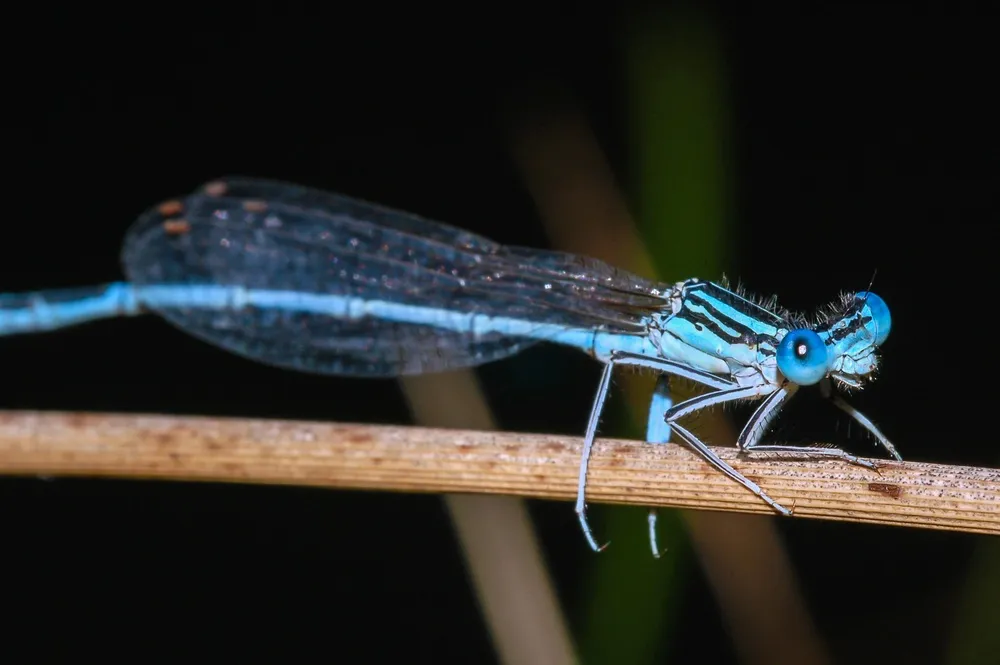
Dragonflies with hawk-sized wing spans and millipedes longer than a human leg lived more than 250 million years ago. Scientists have long wondered why sci-fi bugs don't exist today. The reason has to do with a bottleneck that occurs in insects' air pipes as they become humongous, new research shows.
In the Paleozoic Era, insects were able to overcome the bottleneck due to a high-oxygen atmosphere. Unlike animals with backbones, like us, insects deliver oxygen to their tissues directly and bloodlessly through a network of dead-end tracheal tubes. In bigger insects, this mode of oxygen transport becomes less efficient, but no one has been exactly sure why.
Alex Kaiser of Midwestern University and his colleagues at Argonne National Laboratory and Arizona State University delved deeper by shining X-rays on four living beetle species , ranging in body mass by a factor of 1,000. This allowed the team to measure the exact dimensions of the beetles' tracheal tubes.
Kaiser found that bigger beetle species devote a larger portion of their bodies, proportionately, to airways than do smaller species. And the air passageways that lead from the body core to the legs turn out to be bottlenecks that limit how much oxygen can be delivered to the extremities, Kaiser said.
The team also examined the passageways that lead from the body core to the head. "We were surprised to find that the effect is most pronounced in the orifices leading to the legs, where more and more of the space is taken up by tracheal tubes in larger species," he said.
Kaiser and Argonne biologist Jake Socha also used the results to predict the largest size of currently living beetles. If data on the air passageways to the head were used as a limiting factor, they predicted a crazy-large, foot-long beetle, while the leg data predicted a beetle that matches the size of today's largest living beetle, Titaneus giganteus.
The research is detailed in the Aug. 7 issue of the journal Proceedings of the National Academy of Sciences.
Get the world’s most fascinating discoveries delivered straight to your inbox.
RELATED CONTENT
"This study is the first step toward understanding what controls body size in insects," Socha said. "It's the legs that count in the beetles studied here, but what matters for the hundreds of thousands of beetle species and millions of insect species overall is still an open question."
The research was funded by the National Science Foundation.
Originally published on Live Science.

Robin Lloyd was a senior editor at Space.com and Live Science from 2007 to 2009. She holds a B.A. degree in sociology from Smith College and a Ph.D. and M.A. degree in sociology from the University of California at Santa Barbara. She is currently a freelance science writer based in New York City and a contributing editor at Scientific American, as well as an adjunct professor at New York University's Science, Health and Environmental Reporting Program.