Bizarre Dwarf Planet Wrapped in Water Ice

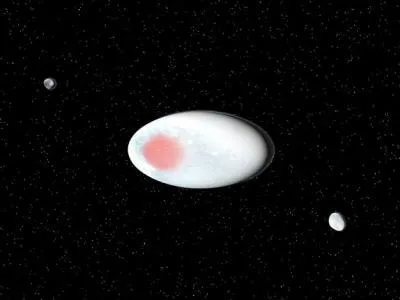
Radioactivity and gravity may be why the strange football-shaped dwarf planet known as Haumea and its moons are unexpectedly sheathed in crystalline ice, shining in space, researchers suggest.
Haumea, named after the Hawaiian goddess of childbirth, orbits the sun beyond the path of Neptune, with two moons in orbit around it named Hi'iaka and Namaka, two of the deity's daughters.
Haumea is a bizarre dwarf planet world shaped like a cigar, or perhaps an American football, measuring about 1,200 miles (2,000 kilometers) long, and makes one full rotation in less than four hours. This is one of the fastest rotation speeds in the solar system, which gave Haumea its odd shape.
Now, surprisingly, an international research team has discovered that 75 percent of Haumea's surface is covered with crystalline water ice. [Video: Dwarf Planet Veiled in Water-Ice]
"Crystalline ice is what we all have in our fridges — the molecules of water are aligned in lattices," researcher Benoit Carry, an astronomer at the European Space Astronomy Centre in Madrid, told SPACE.com.
Moreover, observations from the Very Large Telescope (VLT) at the European Southern Observatory in Chile reveal that 100 percent of Haumea's 250-mile (400-km) moon Hi'iaka is covered with crystalline ice. The same might hold true of Haumea's other moon, the 125-mile (200-km) Namaka, although the scientists did not get a good enough look at it to confirm this.
Instead of crystalline ice, researchers had expected Haumea to be covered in amorphous ice, where the molecules of water are disorganized. Although the dwarf planet receives about 2,000 times less sunlight than Earth, the assumption was that there was still enough ultraviolet radiation in this light to destroy any crystalline ice structures on Haumea over the course of millions of years.
Get the world’s most fascinating discoveries delivered straight to your inbox.
"Since solar radiation constantly destroys the crystalline structure of ice on the surface, energy sources are required to keep it organized," Carry said. [Top 10 Strangest Things in Space]
This energy likely comes from radioactive elements inside Haumea, such as potassium-40, thorium-232 and uranium-238, as well as a roughly equal amount of heat generated by the gravitational tidal forces Haumea and its satellites exert on each other, the researchers find.
These findings shed light on the forces that shape the mysterious Kuiper Belt objects beyond the orbit of Neptune.
"We only know about 2,000 of these objects," Carry said. "Our findings provide an explanation to the presence of crystalline water ice — this provides more information on the evolution processes."
A mysterious dark, reddish spot on Haumea's surface, which contrasts with the whitish color of the rest of the dwarf planet, could in fact "be a richer source of crystalline water-ice than the rest of the surface," said astronomer Pedro Lacerda at Queen's University in Belfast, who did not take part in this study. He did note this discoloration could be due to some kind of irradiated mineral or organic matter instead.
The scientists detailed their findings in the April issue of the journal Astronomy & Astrophysics.
This story was provided by SPACE.com, sister site to LiveScience. Follow SPACE.com contributor Charles Q. Choi on Twitter @cqchoi. Visit SPACE.com for the latest in space science and exploration news on Twitter @Spacedotcom and on Facebook.