













Your Boss Really is Clueless

Your boss and other people in power often really have no idea what you and others feel and think, new experiments suggest.
Power is often defined as the capacity to get what you want or the ability to influence others.
"The powerful have a profound effect on others, and you would naturally hope they would be sensitive to other points of view," said Adam Galinsky, a social psychologist at Northwestern University.
E-power
Galinsky's team wanted to see whether having power changed how well people understood the viewpoints of others. The researchers asked volunteers to recall personal incidents where either they had power over others or others had power over them.
Past studies have revealed that such recollections had exactly the same effects as actually placing people in positions of power or powerlessness, Galinsky said. For instance, regardless of whether people were given power or simply remembered possessing it, they were more likely to assert themselves and take risks.
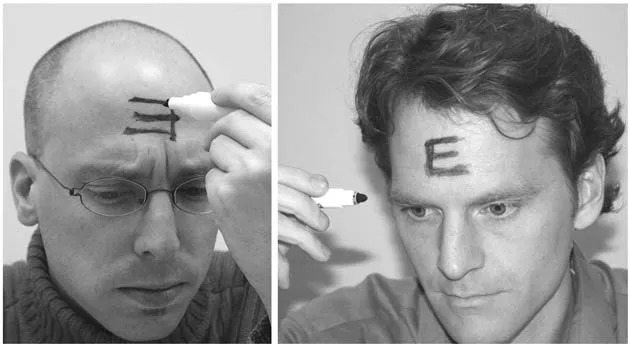
Galinsky and his colleagues at New York University and Stanford then asked 57 student volunteers to draw the letter E on their own foreheads. More than a decade of experiments have shown that people who write the E in a way that is legible to themselves but backwards to others have not thought or cared about how others might perceive the letter. On the other hand, people who draw the E backward to them but legible to others have considered another's point of view.
Get the world’s most fascinating discoveries delivered straight to your inbox.
Galinksy’s study subjects who had recollected power were almost three times as likely to draw the E in a way that was backwards to others than those who recollected an experience of powerlessness [image].
"This corroborates other studies that show when people have power, they are more likely to egocentrically focus on themselves," Galinsky told LiveScience.
E is for empathy
In other experiments, Galinsky and his colleagues gave volunteers a standard test for empathy. Students were shown faces expressing happiness, sadness, fear or anger and then asked what emotions they saw. Those who had recollected being in power beforehand were more likely to misjudge expressions than volunteers who did not, suggesting they were less likely to understand how others felt.
Past studies also have found that people with power became less inhibited and were more likely to act on impulses, while those with less power were more concerned about risks and felt more vulnerable.
"Basically, these findings together paint powerful people as impulsive and oblivious, while the powerless are more cautious and worried," Princeton University social psychologist Susan Fiske said in a telephone interview. Fiske did not participate in the study, which is reported in the latest issue of the journal Psychological Science.
Taking charge
"There are good components to power's effects on a person, in that it helps lead people to action, but sometimes these actions are misguided because the powerful have not taken other perspectives into account," Galinsky said. "It's like having a gas pedal without a good steering wheel."
Future research could look into situations where people both have power and are good at seeing other points of view.
"Leaders are more effective when they pay attention to other perspectives," Fiske said.
