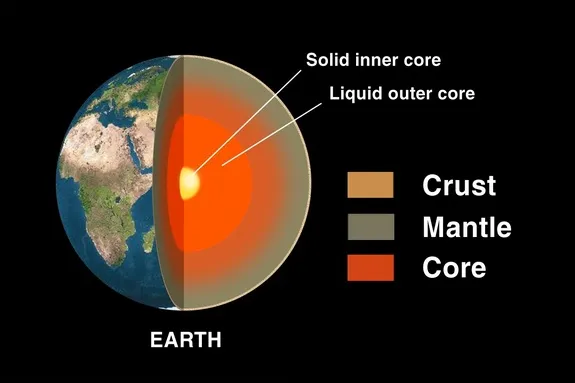

Earth's interior is made up of a series of layers that sit below the surface crust. In order of depth, these layers include the solid, but flowing mantle, the liquid outer core and the solid iron outer core, which helps create Earth's protective magnetic field. The layers can also be categorized into the rigid outer lithosphere (which includes the crust and top portion of the mantle and makes up Earth's tectonic plates) and the athenosphere, the portion of the mantle that is solid, but made up of hot, weak, flowing rock. Read about the latest research on Earth's layers below.

-
 The largest reservoir of hydrogen on Earth may be hiding in its core
Earth's core contains nine to 45 times more hydrogen than the planet's oceans do, according to a new study that could settle a debate about when and how hydrogen was delivered to Earth.
3 Commentsgeology -
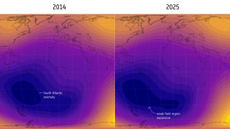 A massive weak spot in Earth's magnetic field is growing, scientists discover
The South Atlantic Anomaly, a huge weak spot in the geomagnetic field off South America, has expanded and sprouted a lobe in the direction of Africa over the past decade.
2 Commentsplanet-earth -
 The geology that holds up the Himalayas is not what we thought, scientists discover
A 100-year-old theory explaining how Asia can carry the huge weight of the Himalayas and Tibetan Plateau needs to be rewritten, a new study suggests.
6 Commentsgeology -
 What's inside Earth quiz: Test your knowledge of our planet's hidden layers
Quiz How's your knowledge of Earth's geology? Flat, round or global?
Quiz -
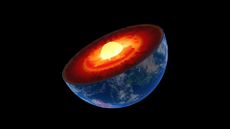 Giant blobs in Earth’s mantle may be driving a 'diamond factory' near our planet’s core
Water driven toward Earth's center by plate tectonics could lead to the creation of diamonds at the boundary between the core and the mantle.
planet-earth -
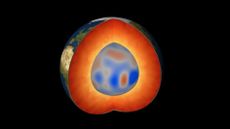 'Completely new' type of magnetic wave found surging through Earth's core
Scientists have discovered a new type of magnetic wave in Earth's outer core, known as Magneto-Coriolis waves. They may be responsible for fluctuations in the planet's magnetic field.
planet-earth -
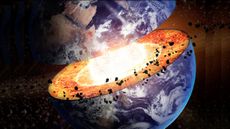 Rare primordial gas may be leaking out of Earth's core
A vast reservoir of the rare gas helium-3 may be hanging out in Earth's metallic core.
planet-earth -
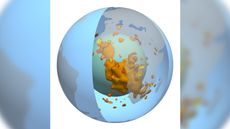 2 giant blobs in Earth's mantle may explain Africa's weird geology
One of Earth's two mysterious mantle blobs is much higher than the other, raising questions about its impact on Earth's surface.
geology -
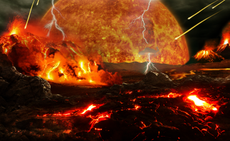 Weird structures near Earth's core may be scars from a primordial interplanetary collision
A collision with a Mars-size planet 4.5 billion years ago may have left a permanent impact on our planet's deep mantle.
geology


