













Photos Show Strange Elongated Martian Crater

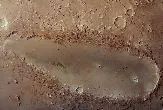
Photos just released by the European Space Agency give an up-close look at the strange, elongated Martian crater known as Orcus Patera.
The crater lies near the equator in Mars' eastern hemisphere, between the volcanoes Elysium Mons and Olympus Mons. It's big, measuring 380 km (236 miles) long, 140 km (87 miles) wide and about 2.3 km (1.5 miles) from rim to floor. [New photo of the crater.]
Astronomers have known about this odd crater for decades, but they still aren't sure how Orcus Patera formed. The word "patera" generally refers to deep, complex or irregularly shaped volcanic craters. But despite its name and its location near some big volcanoes, Orcus Patera's origin may not be volcanic.
The oval structure may instead be an impact crater, scientists think. It may once have been an ordinary — though large — round hole in the ground that was subsequently deformed by tectonic forces. Such forces are evident at Orcus Patera: Long rifts in the Martian surface called "graben" cut across the crater's rim, and "wrinkle ridges" are found throughout the depression itself.
But graben and wrinkle ridges can be found all over the Martian surface, so their presence at Orcus Patera is no smoking gun.
It's also possible that erosion wore away the boundaries between several small impact craters, creating what looks like a single oval crater. But scientists think the most likely origin of Orcus Patera may be a single, oblique impact: A small body struck the Martian surface at a very shallow angle, perhaps less than five degrees from the horizontal.
On this path, the impactor would have dug through a long stretch of Mars' red dirt, creating the bottle-shaped structure we see today.
Get the world’s most fascinating discoveries delivered straight to your inbox.
But the jury's still out, so the true origin of Orcus Patera remains one of many Martian mysteries.
