













Sleeping Babies' Brains Buzz
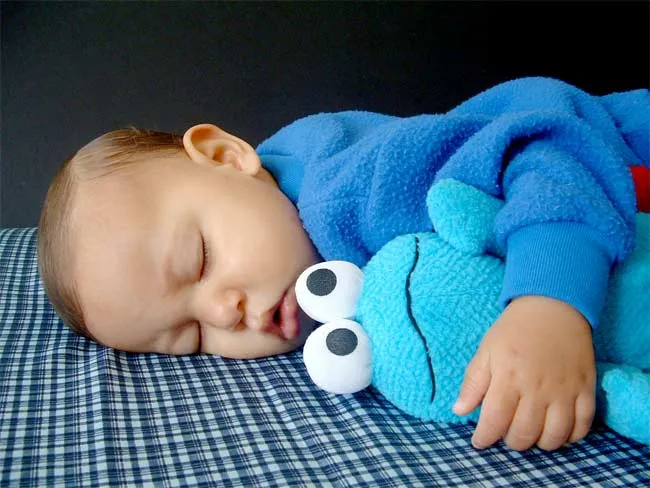
The serene facade of a resting baby belies a brain churning with activity.
A new study, published online this week in the Proceedings of the National Academy of Sciences, reveals active brain regions in sleeping infants.
Other recent research has found evidence in adult brains of 10 so-called resting-state networks, which are clusters of neurons that stay "online" while a person is in a resting state.
Whether the same activity occurred in resting infants was not known.
"This study shows that there is an activity going on in the infant brain," said study team member Hugo Lagercrantz of the Astrid Lindgren Children's Hospital in Sweden.
Peter Fransson, a neuroscientist at the Karolinska Institute in Sweden, Lagercrantz and colleagues scanned the brains of 12 sleeping infants for 10 minutes using functional magnetic resonance imaging (fMRI), finding five resting-state networks engaged in spontaneous activity. As with findings in adult brains, the regions were associated with visual, motor and auditory processing.
What does this mean for a new mom? "This confirms the concept that talking, singing and rocking the baby is not meaningless as earlier believed, but very good for the baby," Lagercrantz told LiveScience.
Get the world’s most fascinating discoveries delivered straight to your inbox.
For neuroscientists, the finding could shed light on how the human brain develops, since fewer networks were found in infant brains compared with those of adults.
"Now we have also shown there is a developmental aspect, that these networks perhaps gradually develop in the infant brain, or through adulthood and up," Fransson said.
- Top 10 Mysteries of the Mind
- VIDEO: Baby Mathematician
- 10 Things You Didn't Know About You
Jeanna Bryner is managing editor of Scientific American. Previously she was editor in chief of Live Science and, prior to that, an editor at Scholastic's Science World magazine. Bryner has an English degree from Salisbury University, a master's degree in biogeochemistry and environmental sciences from the University of Maryland and a graduate science journalism degree from New York University. She has worked as a biologist in Florida, where she monitored wetlands and did field surveys for endangered species, including the gorgeous Florida Scrub Jay. She also received an ocean sciences journalism fellowship from the Woods Hole Oceanographic Institution. She is a firm believer that science is for everyone and that just about everything can be viewed through the lens of science.