















Earth's Largest Lakes Warming, Climate Scientists Find

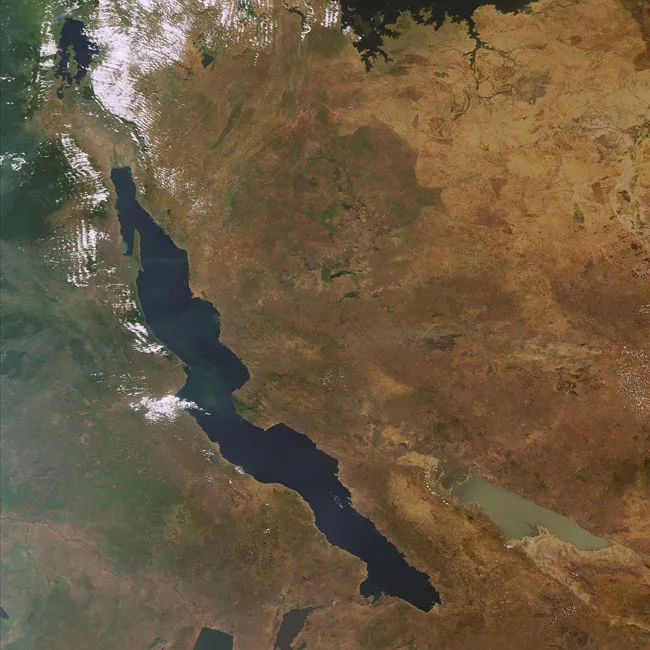
Climate change over the past 25 years is responsible for a temperature increase seen in more than 150 of the world's largest lakes, new satellite data shows.
The results suggest an average warming rate of 0.81 degrees Fahrenheit (0.45 degrees Celsius) per decade, with some lakes warming as much as 1.8 degrees F (1 degree C) per decade. The warming trend was global, and the greatest increases were in the mid- to high-latitudes of the Northern Hemisphere.
Even small changes in water temperature can result in blooms of algae that can make a lake toxic to fish or result in the introduction of non-native species that change the lake's natural ecosystem, the researchers say.
"Our analysis provides a new, independent data source for assessing the impact of climate change over land around the world," said Philipp Schneider, of NASA's Jet Propulsion Laboratory in Pasadena, Calif.
Schneider is lead author of the paper describing the research to be published on Nov. 24 in the journal Geophysical Research Letters.
Schneider and JPL's Simon Hook used thermal infrared imagery from satellites of the National Oceanic and Atmospheric Administration and the European Space Agency. They focused on summer temperatures (July-September in the Northern Hemisphere and January-March in the Southern Hemisphere) due to the difficulty in collecting data in seasons when lakes are ice-covered and/or hidden by clouds. Only nighttime data were used in the study.
They studied lakes that were at least 193 square miles (500 square kilometers) in area from a global database. The selected lakes also had to have large surface areas located away from shorelines, so land influences did not interfere with the measurements. Satellite lake data were collected from the point farthest from any shoreline.
Get the world’s most fascinating discoveries delivered straight to your inbox.
The largest and most consistent area of warming was northern Europe, with a slightly weaker warming trend found in southeastern Europe, around the Black and Caspian Seas and Kazakhstan.
In North America, trends were slightly higher in the southwest United States than in the Great Lakes region. Warming was weaker in the tropics and in the mid-latitudes of the Southern Hemisphere. The researchers say the results were consistent with the expected changes associated with global warming.
The satellite temperature trends largely agreed with measurements taken by nine buoys in the Great Lakes, Earth's largest group of freshwater lakes in terms of total surface area and volume.
The lake temperature trends were also in agreement with independent surface air temperature data from NASA's Goddard Institute for Space Studies in New York.
- 10 Surprising Results of Global Warming
- The Great Lakes: North America's 'Third Coast'
- 2nd Deepest Lake Now Warmer Than in Past 1,500 Years
