













Melting Glacier Reveals Ancient Tree Stumps

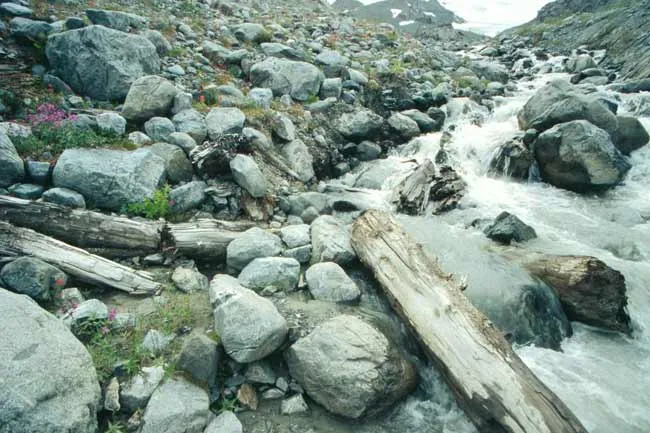
Melting glaciers in Western Canada are revealing tree stumps up to 7,000 years old where the region's rivers of ice have retreated to a historic minimum, a geologist said today. Johannes Koch of The College of Wooster in Ohio found the fresh-looking, intact tree stumps beside retreating glaciers in Garibaldi Provincial Park, about 40 miles (60 kilometers) north of Vancouver, British Columbia. Radiocarbon dating of the wood from the stumps revealed the wood was far from fresh—some of it dated back to within a few thousand years of the end of the last ice age.
"The stumps were in very good condition, sometimes with bark preserved," said Koch, who conducted the work as part of his doctoral thesis at Simon Fraser University in Burnaby, British Columbia. Koch will present his results on Oct. 31 at the Geological Society of America annual meeting in Denver.
The pristine condition of the wood, he said, can best be explained by the stumps having spent all of the last seven millennia under tens to hundreds of meters of ice. All stumps were still rooted to their original soil and location.
"Thus they really indicate when the glaciers overrode them, and their kill date gives the age of the glacier advance," Koch said. The age of the newly revealed ancient trees also indicates how long the glaciers have covered this region.
The recently warming climate released the stumps from their icy tombs, Koch said.
Koch compared the kill dates of the trees in the southern and northern Coast Mountains of British Columbia and those in the mid- and southern Rocky Mountains in Canada to similar records from the Yukon Territory, the European Alps, New Zealand and South America. He also looked at the age of Oetzi, the prehistoric mummified alpine "Iceman" found at Niederjoch Glacier, and similarly well-preserved wood from glaciers and snowfields in Scandinavia.
The radiocarbon dates seem to be the same around the world, according to Koch. There have been many advances and retreats of these glaciers over the past 7,000 years, but no retreats that have pushed them back so far upstream as to expose these trees.
Get the world’s most fascinating discoveries delivered straight to your inbox.
The age of the tree stumps gives new emphasis to the well-documented before-and-after photographs of retreating glaciers during the past 100 years.
"It seems like an unprecedented change in a short amount of time," Koch said. "From this work and many other studies looking at forcings of the climate system, one has to turn away from natural ones alone to explain this dramatic change of the past 150 years."
- Video: Goldilocks and the Greenhouse
- North vs. South Poles: 10 Wild Differences
- Top 10 Surprising Results of Climate Change
