The 'easyJet ecoJet' would emit 50 percent less CO2 than today's newest ...
Environment
Atlantic's 1st Named Storm Forms Early
By Jessica Gresko, Associated Press
posted: 09 May 2007 01:17 pm ET
MIAMI — The first named storm of the year formed Wednesday off the southeastern U.S. coast, more than three weeks before the official start of the Atlantic hurricane season, forecasters said.
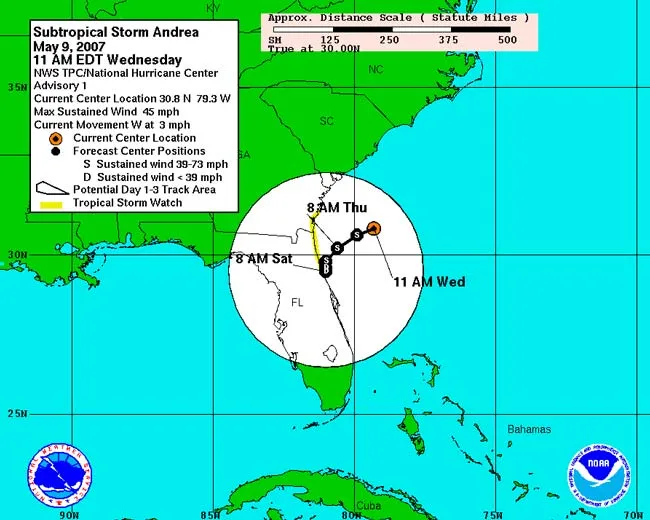
Subtropical Storm Andrea had top sustained winds around 45 mph Wednesday morning and didn't appear to be much of a threat, the National Hurricane Center in Miami said. Still, a tropical storm watch was issued for parts of Georgia and Florida, meaning tropical storm conditions are possible within 36 hours.
“We're not looking at this system strengthening significantly,'' said Richard Pasch, a senior hurricane specialist at the center. “We're not viewing this as a major threat.''
At 11 a.m. EDT, Andrea was centered about 140 miles southeast of Savannah, Ga., and about 150 miles northeast of Daytona Beach. The storm was moving west at about 3 mph.
Forecasters said no significant rain from the storm was expected to fall over land through at least Thursday morning. But wind-driven waves have been causing beach erosion in South Carolina, Georgia and Florida and the ocean has lapped at beachfront homes and condominiums.
Subtropical systems are hybrid weather formations that are usually weaker than hurricanes and tropical storms. They are kind of a half-breed, sharing characteristics of tropical systems, which get their power from warm ocean water at their centers, and more typical bad weather that forms when warm and cold fronts collide, Pasch said.
Forecasters said Andrea has the warm center characteristic of tropical storms but its core is not particularly well defined. In addition, its winds are farther out from the center than they would be in a tropical storm.
Typically about one subtropical storm forms each year, but they often turn into tropical storms. That doesn't appear to be the case with Andrea, senior hurricane specialist Jack Beven said. It only has a small area of warmer water to draw energy from and is also facing dry winds.
He said it wasn't unusual for the storm to form in May, outside the hurricane season that starts June 1 and end Nov. 30.
“What we call the hurricane season is a totally manmade creation. Nature doesn't always pay attention to that,'' Beven said.
Eighteen tropical storms and four hurricanes have been recorded in that month since 1851, and none of the hurricanes made landfall in the U.S. The earliest hurricane to strike the U.S. was Alma in northwest Florida on June 9, 1966.
Private and university forecasters have predicted that the 2007 season will be especially active, producing up to 17 tropical storms and hurricanes and a “well above average'' possibility of at least one striking the U.S. The federal government plans to release its predictions May 22.
The Atlantic basin has been in a busy period for hurricanes since 1995. Some federal forecasters believe this is part of a natural cycle. But the Intergovernmental Panel on Climate Change, a U.N.-sponsored group, says global warming caused by humans has led to an increase in stronger hurricanes.
Subtropical Storm Andrea had top sustained winds around 45 mph Wednesday morning and didn't appear to be much of a threat, the National Hurricane Center in Miami said. Still, a tropical storm watch was issued for parts of Georgia and Florida, meaning tropical storm conditions are possible within 36 hours.
“We're not looking at this system strengthening significantly,'' said Richard Pasch, a senior hurricane specialist at the center. “We're not viewing this as a major threat.''
At 11 a.m. EDT, Andrea was centered about 140 miles southeast of Savannah, Ga., and about 150 miles northeast of Daytona Beach. The storm was moving west at about 3 mph.
Forecasters said no significant rain from the storm was expected to fall over land through at least Thursday morning. But wind-driven waves have been causing beach erosion in South Carolina, Georgia and Florida and the ocean has lapped at beachfront homes and condominiums.
Subtropical systems are hybrid weather formations that are usually weaker than hurricanes and tropical storms. They are kind of a half-breed, sharing characteristics of tropical systems, which get their power from warm ocean water at their centers, and more typical bad weather that forms when warm and cold fronts collide, Pasch said.
Forecasters said Andrea has the warm center characteristic of tropical storms but its core is not particularly well defined. In addition, its winds are farther out from the center than they would be in a tropical storm.
Typically about one subtropical storm forms each year, but they often turn into tropical storms. That doesn't appear to be the case with Andrea, senior hurricane specialist Jack Beven said. It only has a small area of warmer water to draw energy from and is also facing dry winds.
He said it wasn't unusual for the storm to form in May, outside the hurricane season that starts June 1 and end Nov. 30.
“What we call the hurricane season is a totally manmade creation. Nature doesn't always pay attention to that,'' Beven said.
Eighteen tropical storms and four hurricanes have been recorded in that month since 1851, and none of the hurricanes made landfall in the U.S. The earliest hurricane to strike the U.S. was Alma in northwest Florida on June 9, 1966.
Private and university forecasters have predicted that the 2007 season will be especially active, producing up to 17 tropical storms and hurricanes and a “well above average'' possibility of at least one striking the U.S. The federal government plans to release its predictions May 22.
The Atlantic basin has been in a busy period for hurricanes since 1995. Some federal forecasters believe this is part of a natural cycle. But the Intergovernmental Panel on Climate Change, a U.N.-sponsored group, says global warming caused by humans has led to an increase in stronger hurricanes.
Related Items from the LiveScience Store
More Stores to Explore
Most Popular
- Recommended
- Commented
Community
- From Our Blogs
-
From Our Blogs
-
08.19.08 | by Leonard David
SpaceShipTwo Rocket Engine Contract; Smashing News
-
08.12.08 | by Leonard David
Spaceport America: Liftoff of Advanced Technology Craft
-
08.15.08 | by Robert Roy Britt
Bigfoot Turns Out to Be an Opossum
-
08.19.08 | by Leonard David
Animals
Marketplace Links
- Meet the HP ProLiant DL385 G5
- The HP ProLiant DL385 G5 server helps reduce resources and lets you manage systems-or collaborate-remotely
- Science. Technology. Sustainability.
- Visit the new Innovation Channel on LiveScience.com.
- LiveScience Store
- Find everything from weird science to cool gadgets!
- Don't toss it, Recycle it!
- Find local recycling centers now
- FREE Starry Night Widgets
- Get awesome cosmic power in friendly applet form!
- Feel Strongly About Energy Options?
- Speak your mind about technologies and innovations in our forums.
- BP
- Beyond Petroleum
- Facing a Dilemma? Let Geek Logik help.
- Use Algebra to inform your decisions