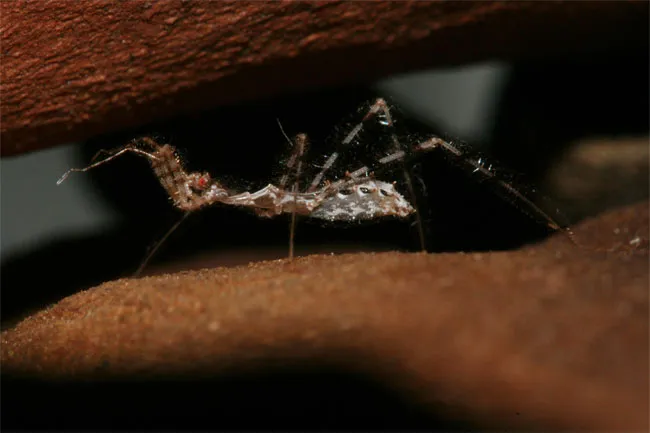
Spiders normally wield webs to ensnare insects and other victims. Now scientists find that assassin bugs turn the tables on these web-spinning arachnids by mimicking prey. Result: Spiders put their guard down, causing nearly instant death, researchers find.
Spiders rely on vibrations in their webs to detect their entrapped quarry. Assassin bugs (Stenolemus bituberus), which are called true bugs (as are water striders, bed bugs and stink bugs), gently pluck and stretch the silk of the webs with their front legs, apparently imitating small or exhausted victims caught within. This lures out the spiders, only for the predators to find themselves prey.
"The assassin bugs have specialized mouthparts, called a proboscis or rostrum, which can be thought of as a modified, sharp 'straw,'" explained researcher Anne Wignall, a behavioral ecologist at Macquarie University in Sydney, Australia. "When a spider is within range of attack, the assassin bug will quickly seize the spider in its forelegs and simultaneously stab the spider with its mouthpart. It will hold the spider tightly in its forelegs until the spider dies, usually within 10 seconds of being stabbed."
Latest Videos From
"The assassin bugs, understandably, are very careful about how they move in the spiderwebs, and so are often very slow moving," Wignall recalled. "I've spent many hours with my nose within centimeters of a spiderweb while watching an assassin bug, which often causes passersby to ask questions or wonder about my sanity if it's in a busy public area."
To confirm whether the bugs were really impersonating entangled insects, Wignall and her colleagues used lasers to monitor the vibrations made by assassin bugs, courting male spiders, leaves falling on the webs and prey such as flies and aphids. They also recorded video of female spider responses to such trembling.
The vibrations made by the assassin bugs sounded very similar to those generated by the leg and body movements of prey, yet quite distinct from those produced by courting males, leaves or the wing beats of prey. Assassin bugs and prey also led to similar responses from female spiders, yet different from reactions elicited by male spiders and falling leaves.
The researchers noted that spiders are dangerous prey, and they occasionally saw assassin bugs get counterattacked, killed and eaten by the arachnids they were hunting. They suggest this might be one reason the bugs only mimic the leg and body movements of prey — spiders often rapidly advanced on prey that beat their wings quickly, and the assassin bugs might prefer to avoid such aggressive, quick attacks.
"I find it incredible to think that an insect, usually regarded as food for a spider, has gained such fine control over the behavior of another predator," Wignall told LiveScience.
The scientists detailed their findings online Oct. 27 in the Proceedings of the Royal Society B: Biological Sciences.

 Live Science Plus