













Ancient Turtle Bones Discovered in Antarctica

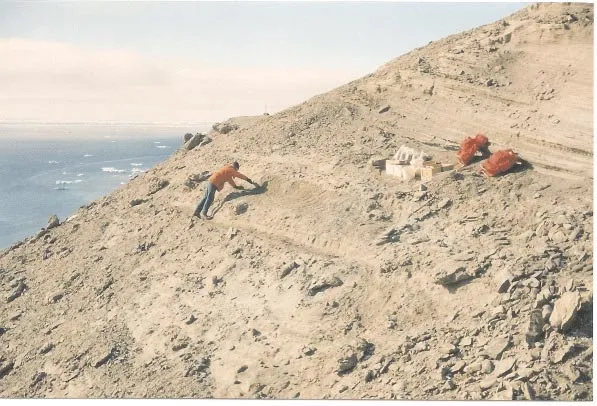
An ancient turtle's fossils, dating from roughly 45 million years ago, were recently discovered in Antarctica.
The bones, only two fragments from a turtle's carapace, or shell, were unearthed in the La Meseta Formation on Antarctica's Seymour Island by an expedition of the Antarctic Institute of Argentina.
While the researchers can't pin down exactly which species the turtle, or turtles – the fragments may not come from one individual – belonged to, the bones are not from any species that was already known to live in the region during this prehistoric era, which is known as the Eocene Epoch.
The discovery could give scientists clues about what the environment and temperatures were like in Antarctica during this time.
"The new fossils show the diversity of turtles was greater in Antarctica in the Eocene than previously thought," said researcher Marcelo S. de la Fuente of the Natural History Museum in San Rafael, Argentina.
During the Eocene, Earth was very different than it is today. At the beginning of this period, Antarctica and Australia were still connected, and Antarctica was much warmer, even containing a rainforest at an early stage. Over time, the pole cooled.
The new turtle bone finding, and its suggestion of high turtle diversity in the area, could indicate that at this point, Antarctica was still warmer than some experts have proposed.
Get the world’s most fascinating discoveries delivered straight to your inbox.
"High diversity is not common in cold waters," de la Fuente told LiveScience. "High diversity is common in tropical waters for instance" or even moderately warm waters, he said.
Vertebrates (backboned animals, including turtles) were actually quite common in the ancient South Pole, de la Fuente said. Teams have uncovered a large collection of shark, bony fish, penguin and whale fossils.
The new find is detailed in the October 2010 issue of the journal Antarctic Science.
