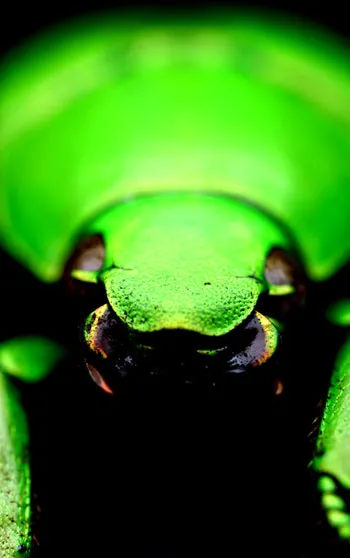
The metallic green sheen of the jeweled beetle glitters only when certain types of light hit tiny structures on the shell of the insect. Otherwise, the green hue disappears, a new study finds.
While pigments account for the colors of flowers, leaves and other structures in nature, some organisms get their bright hues from the way light interacts with the microscopic structure of their skin, feathers or shells — for example, iridescent butterflies and certain sea creatures.
"Iridescent beetles, butterflies, certain sea organisms and many birds derive their unique colors from the interaction of light with physical structures on their external surfaces," said study co-author Mohan Srinivasarao, of Georgia Tech. "Understanding how these structures give rise to the stunning colors we see in nature could benefit the quest for miniature optical devices and photonics."Certain beetles have exoskeletons that exhibit these same properties, making these jeweled beetles prized in textile manufacture and as ornaments in many Asian cultures throughout history.
Latest Videos From
The exoskeleton of the brilliant green beetle (Chrysina gloriosa, or Plusiotis gloriosa) selectively reflects left circularly polarized light, or light whose electric field, from the perspective of the observer, has a left-hand corkscrew structure along the direction it is moving.
The reflecting structures on the beetle's shell consist predominately of three different polygonal shapes — mostly hexagons, though there are some pentagons and heptagons.
Srinivasarao and colleagues Vivek Sharma, Matija Crne and Jung Ok Park used two different microscopy techniques to study the surface structures on the shell of the beetle. What they found confirmed earlier suggestions that the colors are produced from liquid crystalline material, which self-assembles into a complex arrangement of polygonal shapes each less than 10 microns (or one one-thousandth of a millimeter) in size.
"We think these patterns result because the liquid crystal must have defects on the surface when exposed to air, and those defects create the patterns in the beetle’s shell or exoskeleton," Srinivasarao said.
Liquid crystalline materials are valuable industrially, used in displays for laptop computers, portable music players and other devices.
In future research, Srinivasarao hopes to study other insects that use complex structures to create unique colors. He believes that scientists still have a lot to learn by studying the optical structures of beetles and other insects.
The new study is detailed in the July 24 issue of the journal Science.

 Live Science Plus