













Strange New Creature: Giant Shrew or Tiny Elephant?
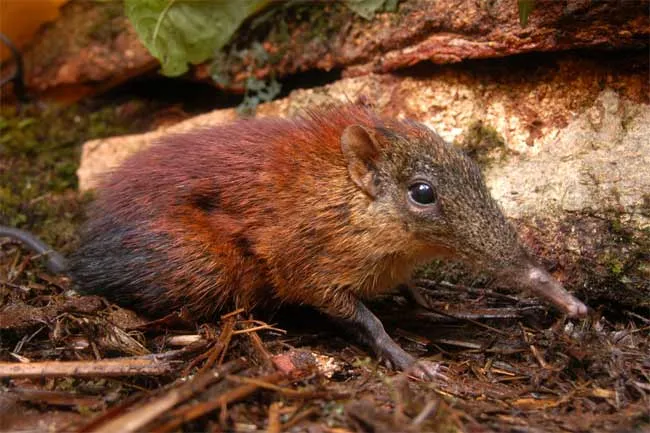
Sporting a trunk-like nose and a jet-black rump, a new species of a bizarre furry mammal was caught on film as it scuttled along a forest floor in Tanzania.
Researchers first sighted the elephant-shrew (Rhynchocyon udzungwensis) in 2005, but not until recently did they confirm the animal as a new species of giant sengi. They filmed the cat-size creature in March 2006 as it twitched its slender snout while searching for insect snacks in the Ndundulu Forest in Tanzania.
But what exactly is it?
Weighing a little more than 1.5 pounds (710 grams), the elephant-shrew is 25 percent to 50 percent heftier than its closest relatives. Its body extends an average of just under two feet (56 centimeters).
"This is one of the most exciting discoveries of my career," said lead author of the new species description Galen Rathbun of the California Academy of Sciences. "From the moment I first lifted one of the animals into our photography tent, I knew it must be a new species—not just because of its distinct coloring, but because it was so heavy."
In the 1970s, Rathbun first described the monogamous behavior of elephant-shrews, which maintain exclusive mating pairs. They got their nickname due to the animals' long, flexible snouts. But recent research has shown that elephant-shrews, also called sengis, are more closely related to elephants than to shrews.
With the addition of the new species, there are now four species of giant sengis identified and a total of 16 species of both giant and normal-size sengis.
Get the world’s most fascinating discoveries delivered straight to your inbox.
Like other giant sengis, the new one has a hunchbacked posture, slender legs and nostrils tipping the end of its nose, though it stands out due to its black rump hairs, distinctive gray face and even larger than normal body size.
Francesco Rovero of the Trento Museum of Natural Sciences in Italy first caught the new species on film in 2005 in the remote Ndundulu Forest in Tanzania's Udzungwa Mountains. The next year, Rovero and his colleagues embarked on a two-week expedition, during which they captured four of the animals and made several observations to confirm the new species.
The recent research, published in the Feb. 4 issue of the Journal of Zoology, suggests the new species is confined to two high-altitude forest blocks in the mountains of south-central Tanzania.
- Video: Long-nosed Mammal Sniffs Out Food
- Rumor or Reality: The Creatures of Cryptozoology
- Vote for the Freakiest Lab Animals
Jeanna Bryner is managing editor of Scientific American. Previously she was editor in chief of Live Science and, prior to that, an editor at Scholastic's Science World magazine. Bryner has an English degree from Salisbury University, a master's degree in biogeochemistry and environmental sciences from the University of Maryland and a graduate science journalism degree from New York University. She has worked as a biologist in Florida, where she monitored wetlands and did field surveys for endangered species, including the gorgeous Florida Scrub Jay. She also received an ocean sciences journalism fellowship from the Woods Hole Oceanographic Institution. She is a firm believer that science is for everyone and that just about everything can be viewed through the lens of science.