













Evolution Occurs in the Blink of an Eye
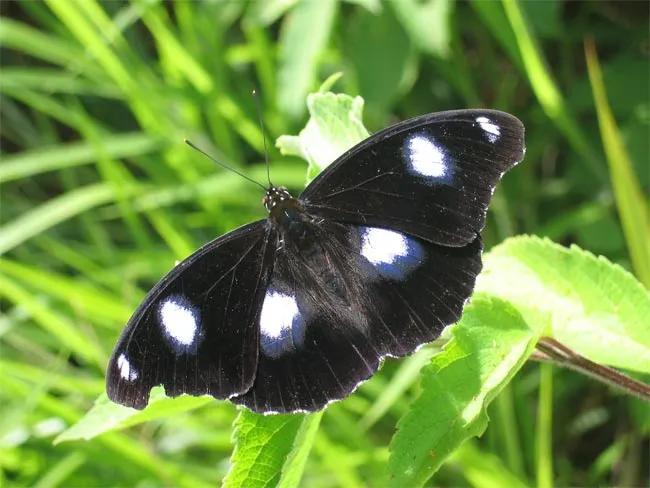
A population of butterflies has evolved in a flash on a South Pacific island to fend off a deadly parasite.
The proportion of male Blue Moon butterflies dropped to a precarious 1 percent as the parasite targeted males. Then, within the span of a mere 10 generations, the males evolved an immunity that allowed their population share to soar to nearly 40 percent—all in less than a year.
“We usually think of natural selection as acting slowly, over hundreds or thousands of years," said study team member Gregory Hurst, an evolutionary geneticist at the University College London. "But the example in this study happened in a blink of the eye, in terms of evolutionary time."
The scientists think the males developed genes that hold a male-killing microbial parasite, called Wolbachia, at bay.
The results, detailed in the July 13 issue of the journal Science, illustrate the power of positive natural selection on “suppressor” genes that thwart the lethal bacteria, allowing the male butterflies to bounce back.
Male killers
Sylvain Charlat of the University of California, Berkeley, and the University College London, along with colleagues, studied the sex ratios of Hypolimnas bolina butterflies on the Samoan islands of Upolu and Savaii, where males had dwindled to 1 percent of the populations in 2001.
Get the world’s most fascinating discoveries delivered straight to your inbox.
The likely culprit was a male-killing parasite, Wolbachia, which lives inside the butterfly’s reproductive cells, preferably female sex cells. With a female host, Wolbachia can hitch a ride to the next generation aboard the mother’s eggs. Since males are “useless” for the bacteria's survival, the parasite kills male embryos.
But the male butterflies found a way to stealthily overcome the parasites. At the beginning of 2006, the scientists found the males made up about 40 percent of Upolu’s butterfly population.
On Savaii, females still dominated the Blue Moon butterfly population (99 percent) at the start of 2006, but by the year’s end, males made up nearly 40 percent.
Secret weapon
The team ran genetic analyses to see if the parasite had somehow vanished. It hadn’t. Wolbachia was still present in butterflies from both islands. Other lab experiments indicated the males had evolved suppressor genes to shield against the parasite.
Unlike genetic tweaks that alter wing color or antennae length, mutations that affect a population’s sex ratio can have a significant impact on the biology of a species, the scientists say.
“The suppressor gene allows infected females to produce males,” Charlat said. “These males will mate with many, many females, and the suppressor gene will therefore be in more and more individuals over generations."
The study was funded by the U.S. National Science Foundation, the U.K. Natural Environment Research Council and the Natural Sciences and Engineering Research Council of Canada.
- Images: Colorful Butterflies
- Mating Game: The Really Wild Kingdom
- Top 10 Most Incredible Animal Journeys
Jeanna Bryner is managing editor of Scientific American. Previously she was editor in chief of Live Science and, prior to that, an editor at Scholastic's Science World magazine. Bryner has an English degree from Salisbury University, a master's degree in biogeochemistry and environmental sciences from the University of Maryland and a graduate science journalism degree from New York University. She has worked as a biologist in Florida, where she monitored wetlands and did field surveys for endangered species, including the gorgeous Florida Scrub Jay. She also received an ocean sciences journalism fellowship from the Woods Hole Oceanographic Institution. She is a firm believer that science is for everyone and that just about everything can be viewed through the lens of science.