













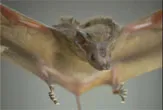
For male bats, intelligence comes at a steep price. A new study found that bat species with large brains have smaller testicles.
The correlation is likely an evolutionary tradeoff between having to maintain a large brain and producing lots of sperm, said Scott Pitnick, a biologist at Syracuse University in New York who conducted the research.
"The male who ejaculates the greatest number of sperm may win at this game, and hence many bats have evolved outrageously big testes," Pitnick said. "Because they live on an energetic knife-edge, bats may not be able to evolutionarily afford both big testes and big brains."
Female bats in many species mate with more than just one male, and sperm can survive in the female's body for long periods of time; this leads to fierce competition between sperm to fertilize the egg. Pitnick suspects that the males with relatively large testes and small brains leave more offspring than larger-brained and less fertile competitors.
In the study, Pitnick and colleagues analyzed 334 species of bats and found that in species with promiscuous females, the males had evolved larger testes but had relatively small brains. In species where the females were faithful to their mates, the correlation was reversed. The study also showed that male fidelity appeared to have no influence over testes or brain size.
In some bat species, the male's testes can make up as much as 8.5 percent of body mass. Of all mammals, bats have the widest range of testes mass: between 0.12 percent and 8.5 percent of body mass.
As a comparison, testes mass in primates (including humans) varies between 0.02 and 0.75 percent.
Get the world’s most fascinating discoveries delivered straight to your inbox.
The research was detailed in a recent issue of the journal Proceedings B of London, a biology journal of the United Kingdom's Royal Society.
Editor's note: A very explicit image of bat genitalia is available here.
- Survival Skills: Why Sex is Good
- Short a Testicle, Sexually Lopsided Beetles Still Do Their Thing
- Kinky Female Bats Share Mates With Their Mothers, Avoid Incest
- Behind the Recent Spate of Vampire Bat Attacks
- World's Ugliest Animals