
 Live Science Plus



Magma Mixing Causes Mount Hood's Explosive Eruptions

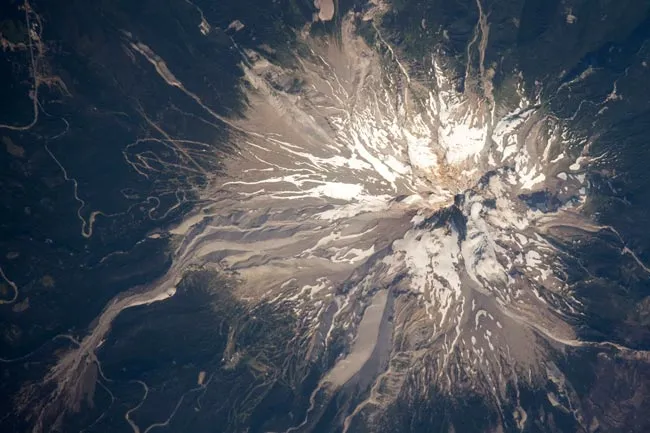
Mount Hood, Oregon's tallest mountain and part of the Cascade Volcanic Arc, goes off like a bomb that explodes after two different liquids are mixed together.
Mount Hood hasn't had a major eruption in hundreds of years, but once two different types of magma below the volcano are mixed, the eruptions can happen within weeks or months, a new study suggests.
The findings, detailed in the Aug. 1 online edition of the journal Nature Geoscience, will help scientists better understand the nature of Mount Hood's past and future eruptions, as well as other volcanoes that erupt by similar mechanisms. This includes a large number of the world's active volcanoes.

"These data will help give us a better road map to what a future eruption of Mount Hood will look like, and what will take place before it occurs," said geoscientist and study team member Adam Kent of Oregon State University in Corvallis. "It should also help us understand the nature of future eruptions and what risks they will entail."
Mixing magma
Geologists are already able to use things like gas emissions, the chemistry of hot springs, ground deformation, local earthquakes and other data to help predict when a volcanic eruption is imminent, Kent said, and the new findings will add even more data toward that goal.
The two types of magma, or molten underground rocks, often involved in volcanic processes are mafic magma, which has less silica and is more fluid, and felsic magma, which has more silica and a thicker, toothpaste-like consistency.
Get the world’s most fascinating discoveries delivered straight to your inbox.
A third type of magma, called andesite, named after the Andes Mountains where it is often found, is composed of a mixture of felsic and mafic magmas.
The rocks around Mount Hood, scientists say, are almost exclusively formed from andesitic magma. And research suggests that when mafic magma intrudes into and mixes with a layer of its thicker felsic counterpart often occurs just prior to an actual eruption.
"The intense mixing of these two types of magma causes an increase in pressure and other effects, and is usually the trigger for an eruption," Kent said. "But this process doesn't happen in all volcanic events. In the Cascade Range, Mount Hood appears to be one volcano where andesitic magma and recharge-driven eruptions are dominant."
That may be because of local crustal conditions, Kent said. Even though the Cascade Range is linked to melting rock from the Cascadia Subduction Zone, some parts of the crust are more difficult than others for magma to move through. Mount Hood appears to be in a region where it takes the extra pressure of magma mixing to cause an eruption.
Mount Hood's past and future
Kent said that researchers study these processes not only to improve their ability to predict eruptions, and to recognize precursors to eruption, but also to assess possible ore deposits associated with volcanic activity, and learn more about the fundamental dynamics of volcanic processes.
Mount Hood's mixing behavior is somewhat different than that of most other Cascade Range volcanoes, the researchers said, including Mount Hood's nearby, more explosive neighbor, Mount St. Helens.
Mount Hood, at 11,249 feet (3,429 meters) tall, is the highest mountain in Oregon and fourth highest in the Cascade Range. Its last major eruption was in the late 1780s, and the effects of this eruption were viewed by members of the Lewis and Clark Expedition in 1805.
Mount Hood is considered a potentially active volcano and the Oregon volcano most likely to erupt, although the chances of that are still small.
- Gallery: Volcanoes from Space
- Which U.S. Volcanoes Are Most Dangerous Right Now?
- Volcanic Hot Spots Explained
This article was provided by OurAmazingPlanet, a sister site to LiveScience.
