 Live Science Plus





You are now subscribed
Your newsletter sign-up was successful
Want to add more newsletters?

Delivered Daily
Daily Newsletter
Sign up for the latest discoveries, groundbreaking research and fascinating breakthroughs that impact you and the wider world direct to your inbox.

Once a week
Life's Little Mysteries
Feed your curiosity with an exclusive mystery every week, solved with science and delivered direct to your inbox before it's seen anywhere else.

Once a week
How It Works
Sign up to our free science & technology newsletter for your weekly fix of fascinating articles, quick quizzes, amazing images, and more

Delivered daily
Space.com Newsletter
Breaking space news, the latest updates on rocket launches, skywatching events and more!
Once a month
Watch This Space
Sign up to our monthly entertainment newsletter to keep up with all our coverage of the latest sci-fi and space movies, tv shows, games and books.

Once a week
Night Sky This Week
Discover this week's must-see night sky events, moon phases, and stunning astrophotos. Sign up for our skywatching newsletter and explore the universe with us!
Join the club
Get full access to premium articles, exclusive features and a growing list of member rewards.
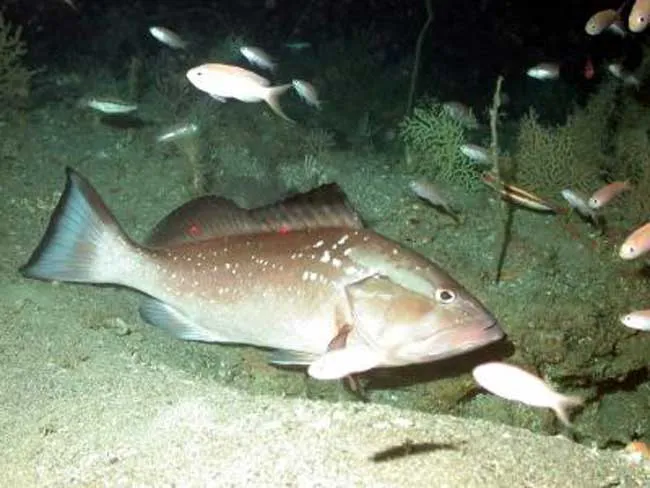
Red groupers were known to excavate structures in the sand in the Gulf of Mexico and along the Southeast U.S. coast, but until now scientists had no idea just how talented and resourceful the fish are.
The groupers excavate and maintain complex holes and, in the process, remove sand from the sea floor, exposing rocks. The fish restructure the flat seafloor into a 3-D matrix, with the newly bared rocks encouraging the settlement and growth of corals and sponges, scientists discovered.
"The sites they created served to attract mates, beneficial species such as cleaner shrimp that pick parasites and food scraps off the resident fish, and a variety of prey species for the red grouper," said Felicia C. Coleman, director of Florida State University's Coastal and Marine Laboratory. "So it is no surprise that the fish are remarkably sedentary. Why move if you are clever enough to make everything you need come to you?"
The findings, announced this week, were published online Jan. 9 in The Open Fish Science Journal.
"Red grouper are the 'Frank Lloyd Wrights' of the sea floor," said University of California-Davis professor Susan Williams, who collaborated with Coleman on an earlier, related study. "We found through a series of experiments that they not only dug the holes but also maintained them by carrying mouthfuls of sediment from the center of the pit to the periphery and expelling them through their gills and mouths, then brushing off the rocks with their tail fins."
The findings are useful in showing how important the red grouper is as part of an interconnected ecosystem.
"Its sea-floor associates include commercially valuable species such as vermilion snapper, black grouper and spiny lobsters," Williams said. "If the groupers are overfished, the suite of species that depends on them is likely to suffer."
- Gallery: Freaky Fish
- Video: The Fish With a See-Through Head
- Gallery: Venomous Fish

