
 Live Science Plus


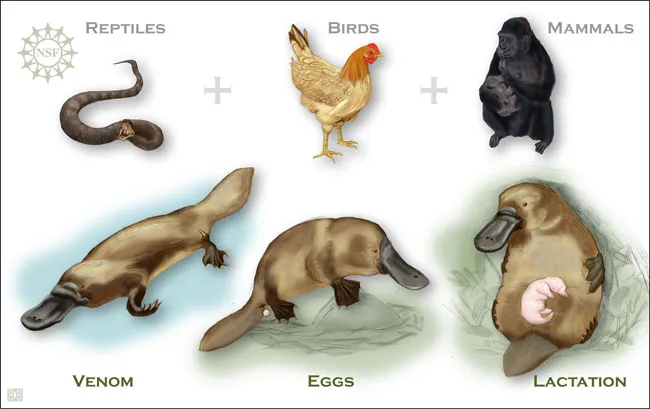
The platypus sports fur like a mammal, paddles its duck feet like a bird and lays eggs in the manner of a reptile.
Nature's instruction manual for this oddball, it turns out, is just as much of a mishmash.

"The platypus is a very ancient offshoot of the mammal tree, so it was 166 million years ago that we last shared a common ancestor with platypuses," said study team member Jenny Graves, head of the Comparative Genomics Group at the Australian National University. "And that puts them somewhere between mammals and reptiles, because they still maintain quite a lot of reptilian characteristics that we’ve lost, for instance they still lay eggs."
She added, "So we can use them to trace the changes that have occurred as we went from being a reptile, to having fur to making milk to having live-born young."
The primitive mammal lives in burrows in Eastern Australia dug along the banks of streams and rivers that it relies on for food. Its flat, streamlined body extends just 20 inches (50 centimeters), tipped with a tail that resembles a ping-pong paddle and four webbed feet. The platypus (Ornithorhynchus anatinus) is one of only two mammals — the other is the echidna (spiny anteater) — that lays eggs. And unlike other mammals, the male platypus can deliver venom from a tiny spur on each hind limb.
To sort out the evolutionary relationships among platypuses and other animals, the team compared the genome of a female platypus nicknamed Glennie with those of humans, mice, dogs, opossums and chickens. (Chickens were included to represent egg-laying animals, such as extinct reptiles, that passed on much of their DNA to the platypus and other mammals in the course of evolution.)
At roughly 2.2 billion base pairs, the platypus genome is about two-thirds the size of the human genome, the researchers found. It shares more than 80 percent of its genes with other mammals.
Like humans, platypuses carry an X and a Y chromosome. But unlike humans, the X and Y are not sex chromosomes. "That means we can go right back to the time when our sex chromosomes were just ordinary chromosomes minding their own business and ask well what happened, what made them into sex chromosomes," Graves said.
The researchers revealed the animal has 52 chromosomes, including 10 sex chromosomes.
The genome also included sections of DNA linked to egg-laying and others for lactation. Since the platypus lacks nipples, the pups suckle milk from the mother's abdominal skin.
Another oddity: When paddling through the water, a platypus keeps its eyes, ears and nostrils closed, and its duck-bill serves as an antenna, sensing the faint electric fields surrounding prey. Even so, the platypus genome reveals the animal held onto genes for odor-detection.
The study, which included more than 100 scientists from across the globe, was funded by the National Human Genome Research Institute (NHGRI).