 Live Science Plus





You are now subscribed
Your newsletter sign-up was successful
Want to add more newsletters?

Delivered Daily
Daily Newsletter
Sign up for the latest discoveries, groundbreaking research and fascinating breakthroughs that impact you and the wider world direct to your inbox.

Once a week
Life's Little Mysteries
Feed your curiosity with an exclusive mystery every week, solved with science and delivered direct to your inbox before it's seen anywhere else.

Once a week
How It Works
Sign up to our free science & technology newsletter for your weekly fix of fascinating articles, quick quizzes, amazing images, and more

Delivered daily
Space.com Newsletter
Breaking space news, the latest updates on rocket launches, skywatching events and more!

Once a month
Watch This Space
Sign up to our monthly entertainment newsletter to keep up with all our coverage of the latest sci-fi and space movies, tv shows, games and books.

Once a week
Night Sky This Week
Discover this week's must-see night sky events, moon phases, and stunning astrophotos. Sign up for our skywatching newsletter and explore the universe with us!
Join the club
Get full access to premium articles, exclusive features and a growing list of member rewards.
When a baseball player tracks a fly ball, he keeps a constant angle between his path and the ball, running along a straight line to intercept.
Bats have a much more difficult task. They must catch insects on the fly, but the bugs they're after move erratically.
The challenge
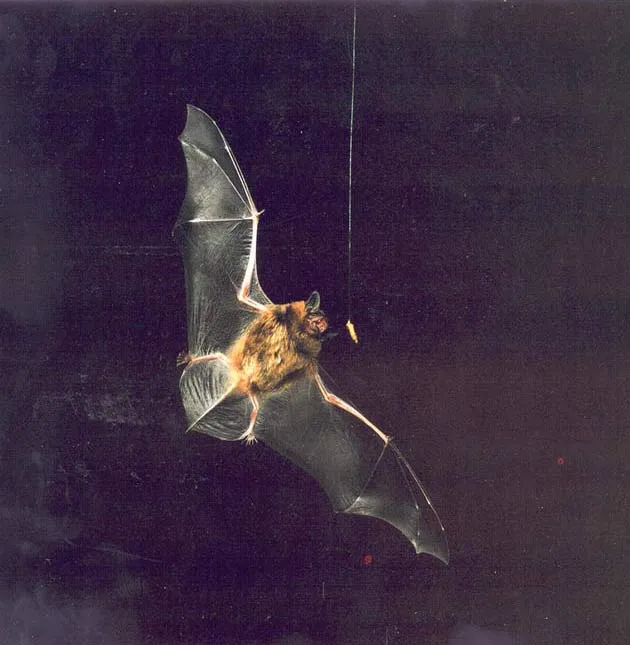
A bat searches the night by emitting ultrasonic pulses through its mouth. The pulses are reflected back by tiny potential meals.
“The bat has a fleeting time window to detect, localize, and capture highly maneuverable and unpredictable prey,” explains Kaushik Ghose at the University of Maryland. “A complete insect chase, from detection to capture, typically takes the bat less than a second.”
Ghose's team made infrared video and sound recordings of big brown bats catching bugs. The work was done in a lab run by Cynthia Moss, a co-author of a paper on the results in the May issue of the journal PLoS Biology.
Lock on
The bat locks its head on a target, much like the baseball player keeps his eyes on the ball. But rather than keeping a constant angle and speed during approach, the bat constantly changes bearing angle and speed. All the while, however, the predator keeps its head locked on the bug.
“If the insect is initially located to the northwest, the bat maneuvers to always keep the target to the northwest while closing distance," Ghose said. “This strategy is called parallel navigation after the parallel nature of the bearing lines. Interestingly, in the late 1940s engineers working on the problem of how to program guided missiles to hit their targets implemented a similar strategy.”
An animation of a typical hunt is available here.
It might seem easier to take a more direct approach. But that's not the case. The bat has worked out ahead of time where it thinks the insect will end up.
"It turns out the bat’s strategy is time-optimal for catching erratically moving targets," Ghose said.

