 Live Science Plus





You are now subscribed
Your newsletter sign-up was successful
Want to add more newsletters?

Delivered Daily
Daily Newsletter
Sign up for the latest discoveries, groundbreaking research and fascinating breakthroughs that impact you and the wider world direct to your inbox.

Once a week
Life's Little Mysteries
Feed your curiosity with an exclusive mystery every week, solved with science and delivered direct to your inbox before it's seen anywhere else.

Once a week
How It Works
Sign up to our free science & technology newsletter for your weekly fix of fascinating articles, quick quizzes, amazing images, and more

Delivered daily
Space.com Newsletter
Breaking space news, the latest updates on rocket launches, skywatching events and more!

Once a month
Watch This Space
Sign up to our monthly entertainment newsletter to keep up with all our coverage of the latest sci-fi and space movies, tv shows, games and books.

Once a week
Night Sky This Week
Discover this week's must-see night sky events, moon phases, and stunning astrophotos. Sign up for our skywatching newsletter and explore the universe with us!
Join the club
Get full access to premium articles, exclusive features and a growing list of member rewards.
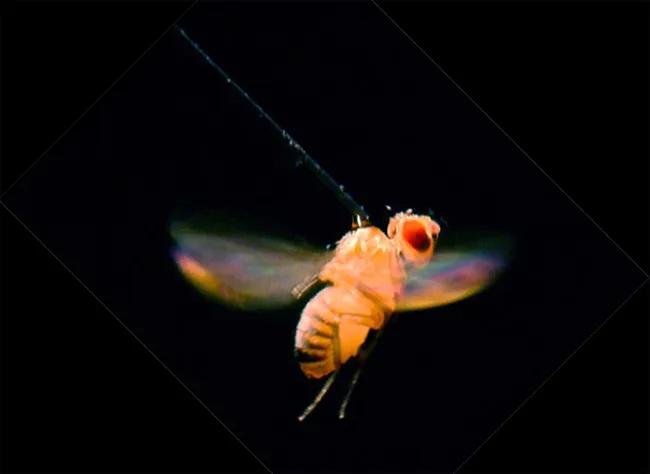
Uncork a bottle of your favorite Cabernet outside in the summer and odds are good a pesky fruit fly will find your glass by the time the glass finds your lips. Turns out, the teensy party crasher navigates using mathematical rules that maximize the chances it will locate your full-bodied drink.
“Wine is extraordinarily attractive to them,” said the new study’s co-author Mark Frye of UCLA. “I wouldn’t be surprised if the animal came from half a kilometer away.”
“So we knew what was causing a fly to steer when it got close to things,” Frye said. The new study, published in the April issue of the journal PLoS ONE, reveals what they didn’t know: why the flies make swift twists and turns when out in the middle of nowhere, far away from obstacles.
Frye and his colleague, Andy Reynolds of Rothamsted Research in England, used two video cameras to track fruit flies in dome-like enclosures, at the bottom of which they hid an odor source. Inside the enclosure, each fly made a bunch of 90-degree turns followed by a longer straight path.
“With all of those small turns they search the local vicinity and then make a foray to move away and then they search that local vicinity again and make a foray,” Frye told LiveScience.
An analysis of the paths showed the flies followed a tried-and-true method for sniffing out the odor.
“Their strategy is trying to optimize two things,” Frye said. "They want to detect something that’s very faint, and they want to move around enough that they don’t get stuck in one place where there aren’t any good smells.”
The fly’s seemingly erratic flight paths match up with a mathematical algorithm called Lévy’s distribution, which optimizes the chances of finding a tasty snack.
Humans do the same thing without realizing it, while, for example, standing in the kitchen and trying to pinpoint the source of a noxious odor. “You stand still and sniff around and realize it’s not here, so you move down to the refrigerator and you sniff again—am I getting warmer or colder?” Frye explained.
- Top 10 Amazing Animal Abilities
- Red Wine May Help Prevent Alzheimer's
- Top 10 Animal Senses Humans Don’t Have
