













Artificial Humans Gills Inspired by Diving Beetles

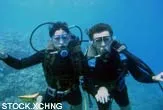
By studying how beetles can trap air to keep from drowning, researchers suggest artificial gills that mimic such a trick could help people breathe underwater.
Scientists in England investigated super-water-repellant surfaces. These possess infinitesimally tiny structures that rise like trees in a forest, on which water droplets rest. The structures trap air between the surface they jut up from and the water on top of them.
Insects and spiders usually drown when submerged. However, aquatic insects such as the great diving beetle Dytiscus marginalis possess rigid hairs on their abdomen that repel water so much they create a silvery film of air that does not collapse. The silk nests of some ground-dwelling spiders and the eggshells of a number of insects also can develop these sheaths of air.
These air layers can essentially behave as gills, allowing oxygen in the water to flow in and carbon dioxide in the air to diffuse out.
Mimic nature
Glen McHale, a physicist at Nottingham Trent University in England, and his colleagues investigated whether synthetic materials could mimic this natural effect. They created a hollow cylinder made of super-water-repellant porous foam, inside which they sealed a device that consumed oxygen. When submerged in aerated water, sensors within the cylinder showed oxygen made its way inside.
The most likely use for this effect would be to supply oxygen for fuel cells to enable miniaturized machines to work underwater without need for stored or external oxygen supplies, the scientists say.
Get the world’s most fascinating discoveries delivered straight to your inbox.
They also note that a surface area of roughly 970 square feet could provide enough oxygen for a single person to survive.
"The actual surface area required would depend on the gases in the water, water movement and the level of oxygen required," McHale told LiveScience.
Such a surface for a person could get folded up to some extent for greater portability. However, corrugating the surface like that would just deplete nearby water of usable oxygen more efficiently, researcher Neil Shirtcliffe explained. "As with fish and sharks, unless water is pumped past or the 'gill' is moving there is little advantage to structuring the surface," he said.
More research needed
How long a machine or person could stay underwater "is indefinite, provided the water does not become deoxygenated," McHale said. However, "if other gases, such as methane, were in elevated levels in the water, such as in stagnant pools, these gases would be transferred into the breathing air as efficiently as oxygen and could potentially cause serious problems."
McHale also cautioned they did not measure carbon dioxide levels within the cylinder, "and it is a buildup of carbon dioxide that would kill people before lack of oxygen." Still, "the rate of removal of carbon dioxide is expected to be high as the gas is very soluble in water."
McHale and his colleagues reported their findings Sept. 4 in the journal Applied Physics Letters.
- The Real Spider-Man
- Invention Allows Humans to Breathe Like Fish
- Human Ears Evolved from Ancient Fish Gills
- Great Inventions: Quiz Yourself
- The Biggest Popular Myths
